October Spotlight: ETC Member Kim Ruyle

October Spotlight: ETC Member Kim Ruyle

From Broadway Student to Produced Playwright

Kim Ruyle, a playwright who has written nine plays—with six already produced and another in the works—has built his career on a blend of passion, preparation, and strategic relationship-building. His journey reflects a deep commitment to the art of theater and a disciplined approach to networking and honing his unique voice.

For over 20 years, Kim has traveled to New York at least three times a year, immersing himself in Broadway shows. “I’d see four or five plays in a weekend,” he says, always attending as a student of the craft. He watched closely to learn: How does a play start? What humor lands with the audience? How do the dramatic elements come together for a satisfying end? This habit of absorbing theater, combined with seeing about 50 shows annually, has been key to his growth as a playwright.

But Kim’s success goes beyond just studying the craft. He brings a three-pronged approach, borrowed from his influence coaching background, into his writing career: credibility, relationships, and a unique voice.

Credibility, for Kim, is built through preparation and continual learning. Relationships are forged through smart, subtle networking. “When I go, I pay attention to who’s directing, who’s the artistic director, and which actors stand out – I say, man, they did a great job and I would like to work with them someday. I often send them a friend request on Facebook afterward or compliment them after the show, which helps me build relationships over time,” he explains, noting that being a known face in local theaters has helped him make key connections that can open the door to productions.

Finding his unique voice has also been central to his success. “If you don’t have something original to say, why should anyone listen? Developing your own brand, your own voice is key. It takes time and effort to discover and hone that voice.”

He continues, “I write plays for mature actors that have an edgy quality to them. I tend to write ‘dramedies’ — stories with a mix of drama and comedy. Even in my most dramatic pieces, you’ll find comedic moments; I believe plays need to entertain and engage the audience. Not to say that I don’t have thought-provoking content in my plays – but they don’t promote a social agenda. I focus on telling a compelling story, one that makes people think, laugh, or cry.”

“I’ll add one more thing,” he says. “Early in my playwriting career I was on a drama skill webcast, and I heard playwright Phil Olson say something that stuck with me: ‘When you finish a play, dont start your next one until you get the first one produced.’ That really resonated with me, and I try to do that now. Out of the nine full-length plays I’ve written, six have been produced, and I think another is about to be. So, it’s not just about writing—you have to focus on getting your work produced as well.


Discipline and Persistence

Kim’s disciplined approach to both writing and networking has led to tangible results. He writes daily, and also makes time to attend theater weekly, dedicates two months each year to marketing his work, and conducts in-depth research to develop stories for new plays. “My current project is set in the 1880s Old West, and I’m deep into research. I think it’s a unique setting for the stage, and I plan to bring in my signature blend of drama and comedy, I hope.”

As Kim’s career shows, success in playwriting requires both craft and hustle—balancing creativity with strategic relationship-building, and always staying a student of the art. He’s an inspiration to me and to all of our ETC members in CreateTheater!

Find out more about Kim’s work at kimruyle.com and read his plays on the NPX.

CreateTheater is an artistic home for new plays and musicals. Thinking of joining? Click here for more information.

What’s the #1 Question I Get Asked?

What’s the #1 Question I Get Asked?

CreateTheater Develops and Produces New Work


Since 2016, CreateTheater has been working with playwrights and musical theater teams to develop and then help produce new work, through general managing industry readings, dramaturgy, writing groups, worksbops, and producing new work in the CreateTheater New Works Festival, the CreateTheater Cabaret, and through partnerships that produce new plays and musicals,

So what do you think the #1 question that I get asked?

Drum roll please: “Will you produce my new play or musical?”


It Takes Time to Produce New Work


Typically a new play will take 3-5 years to get produced; musicals seven years or more. And even if you’re in a position to independently produce your own work on stage doesn’t mean that you can “fast-track” the process.

Theater is the most collaborative art, which means that it takes time to pull the work together. Time to check your script with directors, dramaturgs and company members; time to present readings to see how the audience reacts to the work. Time to rewrite yet another draft, incorporating what was learned in the previous reading, writing group presentation or workshop.

Not every reading should be recorded, especially in the early drafts; you’ll want to change the script to incorporate feedback, rendering the recording outdated almost as soon as it’s edited. Save that for the music-stand industry reading, when you’ll need it to pitch to theaters, directors, producers and investors.

Getting back to the original question, “Will you produce my show,” in the beginning no one will love your show more than you do. But I will be a close second. My goal is to see you get your play produced; sometimes I will produce it.

But it takes time. Most important things do; y0u can’t shortcut development without taking the time to make it great.


So, How Do I Get Produced?


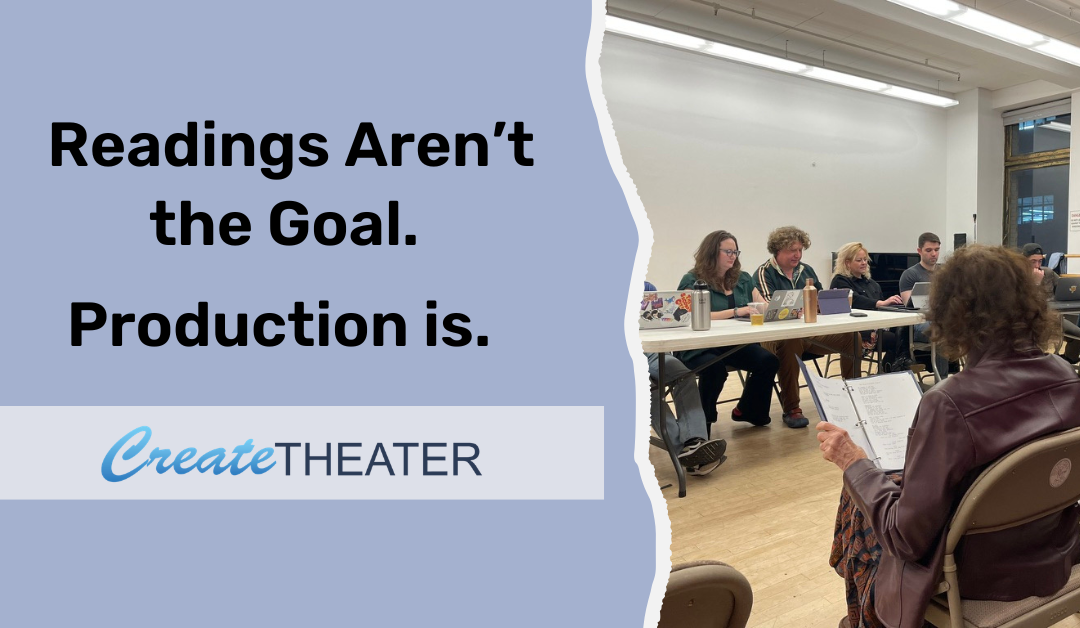
First, write the script (or libretto). Get input from your collaborator, a dramaturg, a writing group – or all three. Then find some friends and do a table reading, often called a “pizza reading” since you can compensate your friends with food.

Make changes to the script, incorporating your discoveries. Check out your new pages with your collaborator, a dramaturg, a writing group – and hold another reading. Make more changes. Do this until you (and your friends) are enthusiastic and feel your play is “ready.”

Ready to submit to theaters, festivals, contests. Ready to submit to possible directors or producers. Make sure that you upload it to y0ur NPX portal, so other writers can read and comment on it as well.

This takes time. But you know what? With each step, your play just keeps getting better and better. And you gain more experience, and get better at your craft, with each iteration. You may even decide to start another play or musical, just for the fun of it, while you submit and continue to develop your first.

These friends, these colleagues, who are so ready (and experienced) to help you with their smart feedback? Here at CreateTheater, these are your fellow playwrights and ETC members, all experienced playwright and musical theater writers. I’m proud that many of our members have been produced Off Broadway, regionally, and in television and film. Some members are actual Tony-award winning producers, looking for new projects.


When Do I Get Produced?


This is a relationship-driven business. First you perfect the work itself, in collaboration with other artists; then you present it to friends, colleagues, and new industry friends that you make through social connections in the business.

From there your network keeps growing. Soon, a friend-of-a-friend, a writing group member’s cousin that works with a famous person’s sister wants to listen to your musical. A theater discovers your play through a submission process and wants to produce it. Your industry reading is so funny that a producer you know asks for the chance to produce it.

These things happen. And they can happen to you, too. Perfect the work, keep writing new shows, keep submitting and making social connections. That’s how you get produced.

CreateTheater is here to help. Thinking of joining? Click here for more information.

The Value of a Theatre Community

The Value of a Theatre Community


The Need for an “Artistic Home”

Theatre is an especially collaborative art. It takes a dedicated creative team to create, develop and produce new work, and always have. Today, collaboration often happens on Zoom, one of the benefits from the pandemic. However, the definition of theater is “live” and must happen first with the creative team, then with the actors and audience in the same space.

As it stands now, a three-week rehearsal schedule is built for commercial success, not development. What’s needed is an “artistic home” to serve as a nurturing ground, to foster creativity, collaboration, and innovation, with other trusted artists.

What is an “artistic home”?

An artistic home, to me, is a supportive environment for theatre artists to explore and experiment with new ideas. It offers a ‘safe space’ where artists can take risks, challenge conventions, and push the limits of their creativity, without fear of judgment, crucial for the development of groundbreaking and transformative work.

Moreover, an artistic home can allow theatre artists a place to collaborate and exchange ideas with a variety of other artists – playwrights, directors, actors, designers, and technicians – within a framework of critical resources and support. Funding, mentorship programs, and networking opportunities are crucial for artists to overcome financial and logistical challenges that hinder the creation of new work.

A true artistic home fosters a sense of belonging, an identity of professionalism, and provides concrete networking channels leading towards production.

CreateTheater is a Theater Community

I’ve founded CreateTheater to be this community for theater artists.

This year so far we’ve:

  • Hosted the CreateTheater New Works Festival Reading Series to give an audience to developing new plays and musicals
  • Provided two residencies that financed two readings, one new play and one new musical
  • Provided networking and mentorship opportunities to both CreateTheater and ETC members
  • Provided dramaturgy and development to 42 new plays and musicals this year
  • Workshopped twelve new musicals with industry experts in our SMASH IT! musical workshops
  • Pitching opportunities to Tony-award winning producers and to artistic directors
  • Created writing groups, workshops and social events to grow your industry connections
  • I pitched 12 scripts to a company for touring and licensing
  • We locked down a large studio to present readings and development space for new projects
  • Creating a cabaret for our first-ever fundraiser (stay tuned)

Need to experiment with form? Let’s do it. What about trying out your latest draft with actors, to see if what you have on the page is working? That’s different than a typical reading, where you invite others in to see the work, or a cold “pizza reading” that you plan with friends to get some feedback. I’ve been to two cold musical readings with minimal prep time, that were absolutely outstanding. We’re now trying to help the work go forward.

I’m proud that CreateTheater has been considered an artistic home for our writers,  as it’s playing a vital role in nurturing new scripts and fostering artistic development. The New Works Festival has proven to be a platform for artists to showcase their work, gain exposure, and receive critical feedback from their peers and industry professionals, helping these artists to refine their craft, develop their unique artistic voice, and establish themselves within the professional theatre community.

I also want to say, as an artist with both a BFA and an MFA, that forming your artistic vision among other established artists gives you a foundation to become, in time, an established artist yourself. Mindset matters; community matters. People you trust to hear your work and offer feedback, matters.

An artistic home, within an engaged theater community, is essential to foster creativity, collaboration, and innovation. A supportive and nurturing environment can allow artists to explore new ideas, collaborate with peers, access resources, nurture emerging talent, and push the boundaries of our art form. By investing in such places, we not only empower theatre artists in the 21st century but also contribute to the growth and evolution of theatre as an art form – which needs some help right now.

Let’s Develop New Work Together

I’ve created CreateTheater as a space where artists can challenge traditional norms and conventions and create some groundbreaking and thought-provoking work. Whenever you gather creative people in a singular space, some wild things can happen… especially in a theatrical hotspot like NYC. The people are here. Is your work here? It needs to be, even if you live somewhere else.

Last spring I offered a free Collaboration Event to introduce creatives to each other online (where we’re providing the space to make their work happen in November), and people have been asking me to start up the ‘Cocktail Hours” that I held during lockdown. So, I’m starting it up again. Would you like to participate? Come join us on the last Sunday of the month, October 27th at 2pm EST.

Join our email list for the link and to stay “in the know” here.

Any other ideas? There will be a “Welcome to CreateTheater and ETC” meet-and-greet webinar on October 29th at 7pm EST. Stop by and meet us and see what we’re all about!


The Need for an Artistic Home

The Need for an Artistic Home


The Need for an “Artistic Home”

Theatre is an especially collaborative art. It truly takes a village to create, develop and produce new work, and that needs to happen face-to-face, with a collaboration of artists that know, like and trust each other. Yes, collaboration can and does happen on Zoom; that has been a decided beneficial outcome from the pandemic. However, theater is “live” and must happen with the actors and audience in the same space.

Theatre’s professional developmental path, as it stands now with its three-week rehearsal schedule, is built for commercial success more than development. What’s needed is an “artistic home” to serve as a nurturing ground, to foster creativity, collaboration, and innovation, with other trusted artists.

An artistic home can provides a supportive environment for theatre artists to explore and experiment with new ideas. It offers a ‘safe space’ where they can take risks, challenge conventions, and push the limits of their artistic abilities. This freedom to explore and create without fear of judgment or failure is crucial for the development of groundbreaking and transformative work.

Moreover, an artistic home allows theatre artists to collaborate and exchange ideas with like-minded individuals. It brings together a diverse community of playwrights, directors, actors, designers, and technicians, fostering a rich and stimulating environment for artistic collaboration. It also can provide critical resources and support necessary for the development of new work, with funding, mentorship programs, and networking opportunities, empowering artists to overcome financial and logistical challenges that often hinder the creation of new work.

It fosters a sense of belonging, an identity of professionalism, and provides concrete networking channels leading towards production.

Need to experiment with form? Let’s do it. What about trying out your latest draft with actors, to see if what you have on the page is working? That’s different than a typical reading, where you invite others in to see the work, or a cold “pizza reading” that you plan with friends to get some feedback. I’ve been to two cold musical readings with minimal prep time, that are absolutely outstanding, and we’re now trying to help the work go forward.

I’m proud that CreateTheater has been considered an artistic home for our writers,  as it’s playing a vital role in nurturing new scripts and fostering artistic development. The New Works Festival has proven to be a platform for artists to showcase their work, gain exposure, and receive critical feedback from their peers and industry professionals, helping these artists to refine their craft, develop their unique artistic voice, and establish themselves within the professional theatre community.

I also want to say, as an artist with both a BFA and an MFA, that forming your artistic vision among other more established artists gives you a foundation to become, in time, an established artist yourself. Mindset matters; community matters. People you trust to hear your work and offer feedback, matters.

An artistic home  is essential to foster creativity, collaboration, and innovation. A supportive and nurturing environment can allow artists to explore new ideas, collaborate with peers, access resources, nurture emerging talent, and push the boundaries of our art form. By investing in such places, we not only empower theatre artists in the 21st century but also contribute to the growth and evolution of theatre as an art form – which needs some help right now.

Let’s Develop New Work Together

I’ve created a space where artists can challenge traditional norms and conventions and create some groundbreaking and thought-provoking work. Whenever you gather creative people in a singular space, some wild things can happen… especially in a theatrical hotspot like NYC. The people are here. Are you?

Last spring I offered a free Collaboration Event to introduce creatives to each other online, and people have been asking me to start up the ‘Cocktail Hours” that I held during lockdown. So, I’m starting it up again. Would you like to participate?

Any other ideas? There will be a “Welcome to CreateTheater and ETC” in the works for August 29, so you can meet us and see what we’re all about then.

I’d love to hear your thoughts as I continue to figure out ways to help all of us develop and produce theater in this ever-changing environment. 

The Artist Isolation Problem

The Artist Isolation Problem

I saved a research study from last fall that I stumbled upon again, that gave stats for overall employment rates in Arts graduates. The research was conducted by Sunil Iyengar, the Director of Research and Analysis at the National Endowment for the Arts. As I am both an artist and an advocate for other artists, I was interested in hearing the findings.

Unsurprisingly, the quick study found an overall loss of employment of artists. Interestingly, those having a college degree in an arts-related field were more likely to be employed in those fields than those who did not hold a BFA/MFA degree. Happy news as a person holding a BFA in Acting/Directing and an MFA in Dramaturgy! However, it also suggested to me that those artists who knew in their bones they were artists were able to sustain employment in the field over the long term. When your art is integral to your identity, you keep creating art.

Also interesting to me was that when the study segregated the results on artists’ participation in their art roughly by age (early career artists were those in their 20s, more established artists were in their 30s through 50s, and late career artists that were in their 60s or 70s) it highlighted the effects of the pandemic on artists.

In general, after the pandemic the study found that:

  • early career artists had a hard time building new connections in their field and were struggling to even maintain those they previously had pre-pandemic.
  • more established artists in their 30s through 50s were generally better connected, and were using those connections to gather in person or discuss art, network and socialize, but weren’t building new networks.
  • late career artists felt largely isolated in their work and personal lives, even though they seemed adept at using social media during the pandemic; they  were still “losing touch with existing professional connections that they had before the pandemic” more than the other age demographics.

In other words, despite the general experience of isolation that we all felt as a result of the pandemic, older artists were already working in the gig economy, and had weathered the last two economic recessions – but there was a “perceived loss of community and collegiality” that came with a “perceived loss of professional opportunity and collective artistic creativity in a digital professional landscape.”

Conclusions?

The study emphasized the importance of serendipity and regular encounters with others as critical to artistic career development, especially those that occur in person in their local professional communities, and encouraged all artists to “gather in person or discuss art, network and socialize.” *

Note the key words “in person.”

My take – artists of every age need to connect, especially to connect in person – but online communities can facilitate those connections, friendships and professional networking.

CreateTheater is a Community of TheatreMakers

From the very beginning CreateTheater has been an online community. I began the company to work with writers across three continents in 2015, on Zoom; soon they began helping each others in Zoom readings, which were almost unheard of at the time. Needless to say, were were ready to go when the world shut down in 2020. Each Monday throughout that year we had a developmental reading on. Zoom, given freely to many different writers just to keep them moving forward (and sane). It established CreateTheater as an online theatre develmental community.

People have told me that they miss the monthly online cocktail parties where people could meet in a fun format and talk about their work at the “cocktail tables” (known as Zoom rooms). We stopped doing these at the end of 2020 when our Zoom readings were Zoom-bombed at the end of 2020 (a traumatic experience if you’ve never experienced it), but I think as a space to network and meet people these cocktail parties were really helpful.

In January 2021 I began our resident writers’ company The Experts Theater Company, aka as ETC (a loving hat tip to Ellen Stewart, the original La MaMa, who has always served as my theatrical role model). Today ETC is a vibrant writers’ residency where writers get to know each other in writers groups, producing groups, and monthly developmental and networking opportunities. It is truly what I had hoped it would be: an “Artistic Home” that supports the creation of new work in a community of artists who encourage, instruct and inspire each other and form strong friendships and collaborations.

As a producer I’m 100% committed to creating producing opportunities for members to see their work on stage, which is why the New Works Festival is such a success.

Creating Theater is Creating Producing Opportunities

As I often say, everything I do is about developing and producing the new work created by these ETC artists. All of my programs – the New Work Festival, the Cabaret Festival, the producing partnerships – are centered around creating oppoortunities for these member artists. I do open up opportunities at times for non-ETC artists, but knowing my members’ work and being able to contribute dramaturgically to the creation of their scripts helps me to talk authentically and enthusiastically about  them, all the time.

I’ve decided to open up the cocktail hours again to anyone who is a theatre maker, of any stripe, including directors and designers. We all learn from each other. It’s also in the summer that I open the doors to new members, and I’m reading new submissions now for the 2024-25 ETC membership and for our developmental partnerships. We’re also planning the 2024 CreateTheater Cabaret Festival, the 2025 CreateTheater New Works Festival, as well as our Smash It! Musical Workshops.

As to the in-person thing, I will continue the summer and Christmas parties that are open to members. but I also believe that we can still connect online, to network, create and collaborate. But look for new in-person opportunities to support you as well, in light of and in consideration of this study.

Have ideas? I’d love to hear them! Reach out to me at cate@createtheater.com

And don’t forget to submit your scripts to createtheater.com/submissions. I want to get to know both you and your work 🙂

* Check out the study for yourself here.