Build Your Audience While You’re Still Building Your Show

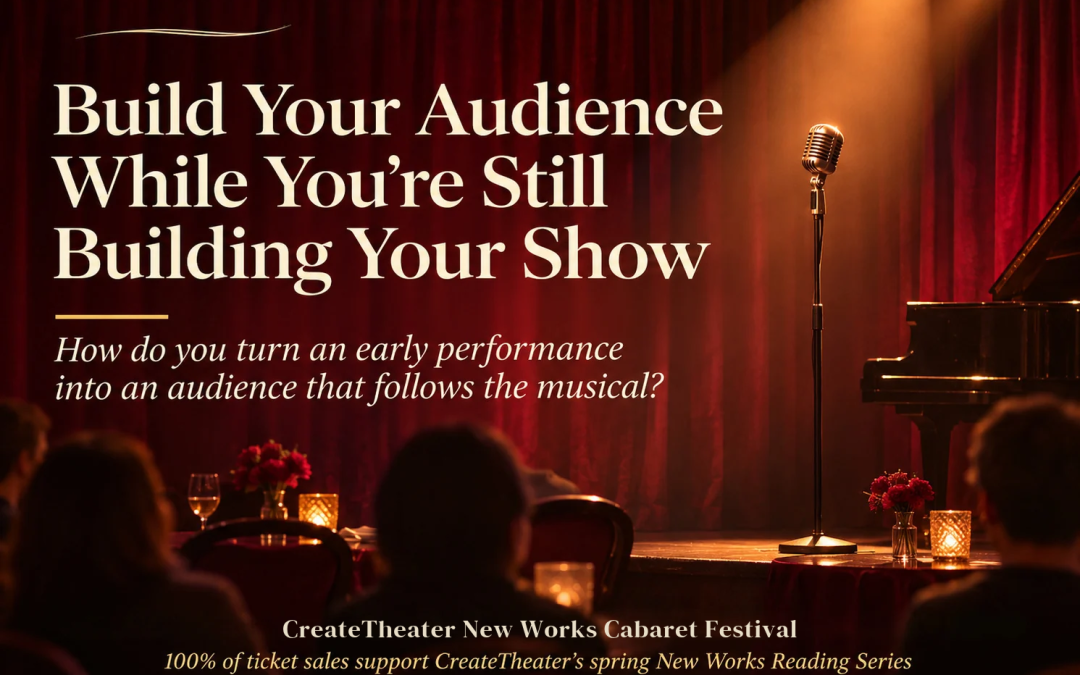
Build Your Audience While You’re Still Building Your Show

How do you turn an early performance into an audience that follows your musical?

Most writers think about building an audience when they’re getting ready to open a show.

But by then, you’ve missed some of your best opportunities.

One of the most valuable things you can do during the development of a new musical is to start building relationships with the people who might eventually become its audience.

Not just people who will buy a ticket to a reading or cabaret. People who become interested in the work itself. Who want to know what happens next. Who remember the characters, respond to the music, and begin to feel that they’ve discovered something worth following.

Audience development doesn’t begin when your show goes into production. It begins when you give people a reason to care.

A Developmental Performance Is an Invitation

When you’re developing a new musical, a cabaret offers something a full production often cannot: the opportunity to introduce your work to an audience before everything is decided.

You don’t need elaborate scenery, costumes, or choreography. You need strong material, compelling performers, and a clear sense of what makes your musical worth experiencing.

A handful of songs can introduce an audience to your characters, the world of your show, and the emotional stakes of the story.

But there’s an important distinction between performing songs from your musical and creating an experience that makes people want to see more.

Your audience doesn’t need to understand every plot point. They do need to feel something.

They need to become curious.

And ideally, when the performance ends, they should be asking the most valuable question a writer or producer can hear:

“When can I see the whole show?”

That’s the beginning of an audience relationship.

Don’t Just Present Your Musical. Give People a Reason to Follow It.

One of the mistakes I see in new musical development is treating each reading, workshop, or cabaret as a separate event.

The creative team works hard to prepare the presentation, invites friends and colleagues, performs the material, and then moves on to the next developmental step.

But what happens to the people who attended?

Do they hear about the next reading? Do they receive news when the musical is selected for a festival? Are they invited to follow its progress?

Or does the creative team start from scratch the next time it needs an audience?

Every developmental presentation should accomplish two things.

  • First, it should help the creative team learn something about the work.
  • Second, it should create an opportunity to build an audience for the work’s future.

The first advances the musical. The second helps create the conditions in which that musical might eventually be produced.

And both require intentional producing.

Five Ways to Turn a Cabaret Audience into Future Supporters

1. Introduce the story, not just the songs.

People connect with characters, conflict, and emotion. Give your audience enough context to understand what they’re listening to and why it matters.

You’re not trying to explain the entire book of the musical. You’re helping them enter its world.

2. Make your audience curious about what happens next.

Choose material that reveals something compelling without resolving everything. A cabaret should satisfy an audience emotionally while leaving them wanting to experience the complete musical.

3. Capture the connection while it’s happening.

Give people a simple way to follow your show’s development: an email list, a website, or a social media account dedicated to the project.

Invite them to stay connected. Don’t assume they’ll remember to look for you six months later.

4. Follow up after the performance.

Thank the people who attended. Share a photograph, a development milestone, or an update about the next step.

Let them know that their presence mattered.

And when you have another presentation, invite them back.

5. Think beyond the people already in your circle.

Friends and family are wonderful supporters, but a future production needs an audience beyond the creative team’s personal contacts.

Who is this musical for? Where do those people gather? Which communities, organizations, and cultural interests might connect with its subject matter?

Start reaching those people now.

The audience you build during development can become your most valuable source of early advocates when the show is ready to move forward.

Discover Three New Musicals on November 24

This philosophy is one of the reasons we created the CreateTheater Cabaret Festival.

On November 23 and 24, six new musicals will have the opportunity to introduce their work to New York audiences at the Laurie Beechman Theatre.

Last week, we introduced our November 23 musicals: Alexsei’s Quest, Bikers in Camelot, and Rewind.

This week, I’d like to introduce the three musicals taking the stage on Tuesday, November 24.

SECRETS: LOVE, LOYALTY & CRIME

Book, Music & Lyrics by Mark Sherry

Against a backdrop of the WWI, economic turmoil and rising political extremism, Rose, one of Australia’s first female lawyers, agrees to defend her brother-in-law Joe against charges of arson and treason. She despises his politics, but family loyalty demands that she stand beside him—even as she begins to question his innocence.

With her sister’s happiness at stake and a prosecutor determined to seek revenge, Rose must confront the limits of her professional confidence and decide how far she’s willing to go for family.

THE CANDLE

Book, Music & Lyrics by Zach Walters

A year after losing his grandfather, college senior Josh is struggling with grief, adulthood, and the relationships he hasn’t quite figured out.

When lighting a memorial candle unexpectedly brings his grandfather Charlie back for one extraordinary evening, the two embark on a nighttime journey through Boston—reconnecting across generations and discovering what it means to move forward without leaving love behind.

JULIE D’

Book, Music & Lyrics by Rich Buley-Neumar and Michael McCarthy

Before there were rock stars, there was Julie d’Aubigny.

A sword-wielding, convention-defying opera singer in the France of Louis XIV, Julie lived a life too extraordinary to be contained by the expectations of her time.

With a voice to match her fearless personality, she challenged convention, embraced adventure, and became the stuff of legend.

Three very different musicals. Three different worlds. Three opportunities for audiences to discover something new.

And for these creative teams, the performance is more than a chance to share songs. It’s an opportunity to find the people who may want to follow their musicals into the future.

Your Ticket Helps Create the Next Opportunity

There’s another reason this Festival matters.

100% of ticket sales from the CreateTheater Cabaret Festival will support performance space for our spring New Works Reading Series.

That means when you purchase a ticket, you’re doing more than attending an evening of new musical theater.

You’re helping CreateTheater provide the space where additional new plays and musicals can take their next developmental steps.

One audience helps create opportunities for the next group of theatermakers.

That’s how an artistic community grows.

Build the Relationship Before You Need the Audience

If you’re developing a new musical, think about your next presentation differently.

Yes, use it to test the material. Listen carefully to the audience. Notice where they’re engaged, where they’re confused, and what they respond to emotionally.

But don’t stop there.

Ask yourself what you’re doing to make sure those people can remain part of your musical’s journey.

Because the audience you build today may become the people who fill the theater tomorrow.

And when someone tells you they can’t wait to see the entire show, make sure you have a way to tell them when that day arrives.

Development should lead somewhere. Bring your audience along for the journey.


Join Us at the CreateTheater Cabaret Festival

November 23–24, 2026
The Laurie Beechman Theatre | New York City

Monday, November 23: Alexsei’s Quest, Bikers in Camelot, and Rewind

Tuesday, November 24: SECRETS: LOVE, LOYALTY & CRIME, The Candle, and Julie D

Discover six new musicals, meet the creative voices behind them, and help support the next generation of new work.

Get Your Tickets to the CreateTheater Cabaret Festival

Two evenings. Six new musicals. The chance to discover something wonderful before the rest of the world does.

See The Blue Violinist Over West End Avenue Off-Broadway!

Use the code CREATE20 for 20% off CreateTheater readers.

Not sure what your project needs next?

Subscribe to The Producers Room for weekly insights and guidance on how to move new work forward today.

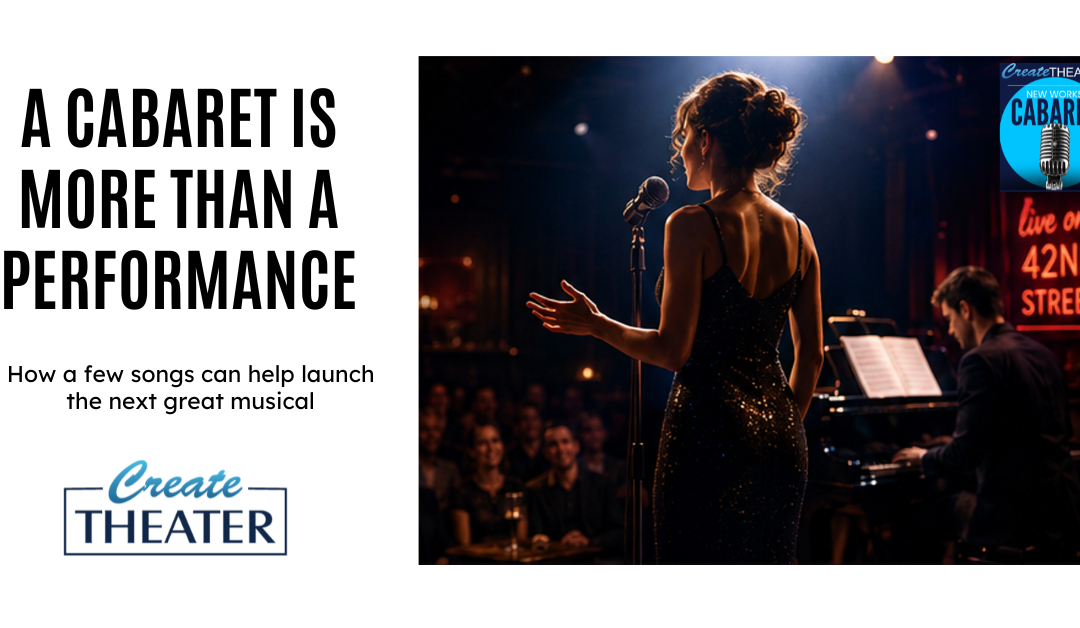
A Cabaret Is More Than a Performance

A Cabaret Is More Than a Performance

What makes an audience want to see more of a new musical?

Sometimes, all it takes is one song.

A character steps forward, begins to sing, and suddenly we’re inside a story we didn’t know existed five minutes earlier. We understand something about this character’s world, what they want, and what might stand in their way.

And when the song ends, we want to know what happens next.

That moment of curiosity is one of the most valuable things a musical theater writer can discover during development.

It’s also why I believe that a well-designed cabaret is much more than a performance.

  • It’s a development opportunity
  • It’s an audience-building strategy
  • And sometimes, it’s the first step toward a future production.

A Musical Doesn’t Have to Be Finished to Find Its Audience

One of the challenges of developing a new musical is that full productions are expensive. Even a staged reading requires actors, musicians, rehearsal time, and considerable coordination.

A cabaret offers another possibility.

By selecting a handful of songs from a developing musical and presenting them in a more intimate setting, writers can introduce audiences to their work long before the show is ready for a full production.

And those songs can accomplish quite a lot.

  • A strong opening number can introduce us to an unfamiliar world.
  • A character song can make us care about someone we’ve only just met.
  • A duet can reveal a relationship full of conflict, humor, or longing.

The key is choosing songs that do more than demonstrate the composer’s musical ability.

They should make us curious about the story.

The question isn’t simply whether an audience likes the songs.

It’s whether those songs make the audience want to experience the musical.

That’s an important distinction.

What Can a Cabaret Teach You About Your Musical?

When we work with musical writers at CreateTheater, I encourage them to think of every developmental presentation as an opportunity to learn something specific.

A cabaret can help answer several important questions:

  • Do audiences understand the world of the musical? Can they begin to imagine the larger story from just these few moments?
  • Are the characters compelling? Does the audience connect emotionally with someone they have only just met?
  • Do the songs advance the storytelling? Are we hearing a dramatic moment, or simply an attractive song?
  • Does the musical have a recognizable identity? Can audiences sense what makes this particular show different from everything else?
  • Do people want to know more? After the performance, are they asking questions about the characters, the story, and when they can see the full musical?

That final question may be the most revealing.

Applause is wonderful, but curiosity? Well, that tells us something different.

When someone approaches a writer afterward and asks, “What happens to that character?” or “Where can I see the rest of this show?” the performance has accomplished something beyond entertainment.

It has created an interested audience.

Of course, a positive cabaret response doesn’t prove that the complete book works or that a musical is production-ready. Those questions require other kinds of development. But a cabaret can tell us whether the central promise of the musical is reaching people.

And that’s valuable information.

The Cabaret as an Audience-Building Strategy

Too often, writers wait until a musical is finished before thinking seriously about who might want to see it.

I believe that audience development should begin much earlier.

A cabaret gives writers a chance to introduce their work to people who can become part of its future: theatergoers, potential collaborators, supporters, and perhaps even producers.

These audiences aren’t just watching a performance. They’re discovering a new musical while it’s still taking shape.

They might follow its development, attend a future reading, recommend it to friends, or help introduce it to someone who can move the project forward.

This is how a musical begins to develop a life beyond the writing room.

You don’t have to wait until opening night to start building an audience. Build your audience while you’re still building your show.

Discover Three New Musicals at the CreateTheater Cabaret Festival

On November 23 and 24, CreateTheater will bring six developing musicals to the Laurie Beechman Theatre in New York City.

Each musical will have the opportunity to introduce its characters, musical world, and storytelling voice to a live audience.

On Monday, November 23 at 7pm, we’re presenting three projects:

ALEXSEI’S QUEST

Book and lyrics by George Pfirrmann, Music by Jamie Allen

A new musical taking its next step toward the stage, ALEXSEI’S QUEST is also one of the projects scheduled for CreateTheater’s 2027 Theatre Row Showcase Series. CreateTheater jumpstarted the project by introducing George and Jamie to each other in our Collaboration Meetup, and gave space for a week-long development process for the first reading.

The cabaret offers an opportunity for audiences to encounter this imaginative fantasy about the Russian dissident Alexsei Navalny before the larger Showcase presentation at Theatre Row next year.

BIKERS IN CAMELOT

By Wendy Bichel, with music direction by Ken Bichel

BIKERS IN CAMELOT joins the festival as another original musical in development.

First presented to sold-out audiences in Mexico with later development in CreateTheater, this original new work will introduce audiences to selections from the score while giving the creative team an opportunity to experience how the material connects with New York audiences.

REWIND

Book and lyrics by Michael DiGaetano, music by Adam Shenk

REWIND continues its developmental journey with CreateTheater with a presentation of songs from the musical.

If you know Michael, you know his snappy dialogue and witty lyrics. For audiences new to his work, it’s another opportunity to discover an original musical being developed in-house in CreateTheater. For Michael, it’s a chance to hear how this musical resonates with audiences beyond our development room.

These three musicals have followed different development paths, but they share something important: CreateTheater has been part of each journey, connecting collaborators, providing development opportunities, and helping the work find its next audience.

On November 24, we’ll introduce three more musicals: SECRETS, THE CANDLE, and JULIE D. Again, all developed in-house.

Your Ticket Helps Create the Next Opportunity

This year’s CreateTheater Cabaret Festival is also a fundraiser for our spring New Works Reading Series.

100% of festival ticket sales will support reading space for new works in New York City.

That means attending the festival accomplishes two things: you get to experience original musical theater in an intimate setting, and you help create the next development opportunity for new work.

At CreateTheater, we don’t just develop new work. We help artists understand what their work needs next—and create opportunities to move it forward.

  • Sometimes that next opportunity is a reading.
  • Sometimes it’s a workshop.
  • Sometimes it’s a production.

And sometimes, it begins with a few songs in a cabaret room.

Before choosing songs for a cabaret, ask yourself: What do I want an audience to be curious about when the last note ends?

Come discover what might be next.

CreateTheater Cabaret Festival
November 23–24, 2026
Laurie Beechman Theatre, New York City

Get Tickets to the CreateTheater Cabaret Festival


See the Work. Support What Comes Next.

THE BLUE VIOLINIST OVER WEST END AVENUE
Now playing Off-Broadway at Theatre Row.
Learn More & Get Tickets

CREATETHEATER CABARET FESTIVAL — NOVEMBER 23 & 24
Get Cabaret Festival Tickets


See The Blue Violinist Over West End Avenue Off-Broadway!

Use the code CREATE20 for 20% off CreateTheater readers.

Not sure what your project needs next?

Subscribe to The Producers Room for weekly insights and guidance on how to move new work forward today.

You Don’t Have to Live in NYC to Develop Your Work in NYC.

You Don’t Have to Live in NYC to Develop Your Work in NYC.

New York Development. Global Community.

One of the things I find myself thinking about more and more is geography.

For a long time, most serious theater development was tied to New York. If you wanted to develop a new musical professionally, the assumption was that you needed to be here — physically here in NYC — within reach of the rehearsal rooms, the readings, the writers’ groups, the industry conversations, and the people, in order to be successful.

That is no longer completely true.

Geography no longer has to limit access to a professional development process.

You don’t have to live near New York to develop your work in New York.

At least in the beginning.

CreateTheater is not an online education company. ETC is not simply a collection of Zoom classes. What we do is make it possible for serious writers, wherever they live, to develop their scripts while remaining connected to a professional New York theater development process.

The Experts Theater Company — ETC, our Theater Residency program within CreateTheater — attracts writers from all over the world because they can belong to a NYC-based professional theater company that is actively developing their work without having to move to one of the most expensive cities in the world.

That is a very different proposition from taking an online class.

It means becoming part of an ongoing professional artistic community.

Our Writers Live Across the Globe

Jarlath Jacobs lives in Como, Italy. She is continuing to develop JACQUES AND JILL with us after we produced an earlier version in 2022. She returned to the work because she wanted to make significant changes to the story — and ETC gave her a community that already knew the musical and could help her rediscover it.

Wendy Bichel joins us from Mexico.

Mark Sherry works with us from Brisbane, Australia.

The geography is different, but the artistic conversation remains centered in New York: professional development standards, industry expectations, production readiness, readings, workshops, and the larger question of how a project moves toward presentation and production.

And the community matters just as much as the artistic work.

That became especially clear to me when Michael Riggs, one of our writers from Adelaide, Australia, came to New York for a visit.

By the time he arrived, he already knew so many people through ETC that he didn’t feel as if he were arriving in a strange city and starting from scratch.

He had a whole circle of friends waiting for him.

We ended up throwing him a party at citizenM in Times Square.

And I remember thinking:

This is part of what we have built.

Not just a program.

Not just a series of readings.

A professional artistic community that exists across geography — and becomes very real when people finally find themselves in the same room.

Theater Artists Need More Than Feedback

I knew even before the pandemic that writers needed more than notes.

They needed continuity.

They needed people who knew the work over time, who could remember what the previous draft was trying to solve, and who could say:

“Yes, this scene is stronger — but now you have to clean up the opening number, because this changes it.”

That kind of feedback is different because it comes from people who understand the larger developmental journey.

Writers need to know what their next question actually is.

They need colleagues who show up for their readings.

And they need an artistic community they can trust.

That sense of belonging is a huge part of ETC.

If you are writing a musical in Brisbane, Como, Mexico, or somewhere else entirely, you may have excellent local collaborators. But you may still want to remain connected to the New York theater ecosystem — not because New York is the only place where theater matters, but because it remains an important professional marketplace and development center for new work.

Technology simply makes it possible to stay in that conversation.

It expands the room.

What it does not do is remove the need for standards.

Professional Development — Through Zoom?

A Zoom room is not automatically a professional development room.

A reading is not valuable simply because people showed up to read it.

A workshop is not useful simply because someone gave you notes.

The value comes from the rigor and professionalism of the process.

Who is in the room?

How experienced are they in developing new musicals or plays?

What question are you trying to answer?

What happens after the reading?

Does the writer understand what needs to change?

Does the writer understand what the next step should be?

Can the writer trust the feedback?

These are the same questions I would ask if the creative team were sitting around a table on 42nd Street at the West Bank Cafe after a reading instead of talking on Zoom.

It matters who is in the room.

The geography has changed.

The artistic expectations have not.

The digital room can also strengthen the development process because writers do not have to wait until they can afford to fly to New York, rent housing, and organize an entire trip just to keep the work moving.

They can continue developing the script at home while staying inside a professional process.

Then, when the project reaches the point where it truly needs bodies in a physical room — staging, choreography, design, audience response, production rhythm — we make that happen here in New York.

“Zoom Theater” Will Never Replace Live Theater

Online development is not a replacement for live theater.

It is a way to get the work ready for the moment when live development becomes necessary.

There are questions you can answer around a virtual table.

There are questions you can only answer when actors step into the roles in a physical room.

And there are questions you cannot answer until an audience is sitting in front of you.

For some work — especially scripts that depend heavily on physical comedy, choreography, staging, or a particular performer’s relationship with an audience — Zoom has obvious limits.

Online development is not right for every project.

But eventually, every script needs to meet an audience.

A creative producer’s job — and an artistic director’s job — is to know what each project needs next.

The writer may be in Brisbane, Como, Mexico City, or Manhattan. What matters is the rigor of the process, the quality of the artistic conversation, and the people who stay with the work over time.

Because serious work still needs a serious room, with experienced people in it.

And serious artists need an artistic home.

That is what we have built in ETC.

I am deeply proud of this company and of the talented theater artists around the world who make it what it is.

You don’t have to live in New York to develop your work in New York anymore.

But you do need a community that knows the work and can help you move it forward.

Not sure what your project needs next?

Subscribe to The Producers Room for weekly guidance on moving new work forward.

The Next Step After a Successful Workshop

The Next Step After a Successful Workshop

One of the most common mistakes I see in new-work development is the assumption that there is a correct sequence.

First a reading. Then a workshop. Then a showcase. Then, if all goes well, a production.

But that isn’t really how development works.

A successful developmental step does not automatically tell you what comes next. It gives you better information about the work.

And then someone has to decide what to do with that information.

That, increasingly, is how I think about the work of the creative producer.

The question is not simply, “Was this successful?”

The more useful question is:

“What does this particular project need next?”


Sometimes a production sends you back into development

This week at CreateTheater, we returned to JACQUES AND JILL, a new musical by Jarlath Jacobs.

That project has actually been on a stage before. We produced an earlier version of the musical at Theatre Row as part of our 2022 New Works Festival.

It would be easy to look at that history and assume the next step should simply be another, larger production.

Instead, Jarlath went back to the work.

Now living in Como, Italy, she has been substantially rethinking the story and developing what has become JACQUES AND JILL. We are hearing the new version again in our Monday Night Reading Series, act by act.

That is not going backward.

It is development doing exactly what it is supposed to do.

Sometimes putting a piece in front of an audience reveals that the fundamental idea is worth pursuing—but that there is another, stronger version of the story still waiting to be discovered.

A prior production does not mean the work can never return to the development room.

Sometimes that is precisely where it belongs.


Sometimes a successful workshop reveals the next rewrite

We had a very different experience recently with LITTLE THINGS, the new musical by David H. Smith.

After developing the musical through CreateTheater—and previously presenting both an industry reading and a cabaret version of the work—we brought it to Philadelphia for a workshop production.

The performance sold out.

The audience response was wonderful.

It was a real success.

And there will still be rewrites.

One of the clearest things we learned from seeing the full musical on its feet is that the overall running time needs to come down.

That is exactly the kind of information a workshop is supposed to give you.

A workshop allows you to experience the show in time and space. You begin to feel pacing differently. Transitions that seemed perfectly reasonable on the page suddenly have weight. Songs, scenes and storytelling beats begin competing for the audience’s attention in ways that are almost impossible to judge from a table reading alone.

The success of LITTLE THINGS did not eliminate the need for development.

It made the next developmental task clearer.

And that is a success too.


And sometimes you don’t need the workshop at all

Then there is The Blue Violinist Over West End Avenue.

Its path has been completely different.

We did not move the play through a workshop production or a showcase.

There was a succession of readings and extensive script development. But because of the strength and timeliness of the story, the decision was made to move the play directly toward an Off-Broadway production.

That did not mean the script stopped developing.

Last week, the writer, the director and I spent more than six hours together in person working through the play.

We read it aloud.

We stopped.

We questioned moments.

We adjusted language.

We worked through transitions, beats, intentions and the internal logic of scenes moment by moment.

It was extraordinarily detailed work.

And yet it was happening on a play already heading into production.

Why?

Because the developmental process is not determined by which boxes you have checked.

It is determined by what the work still needs.


Every show needs something different

That is why I resist prescriptive development pipelines.

A reading can be invaluable when you need to hear structure, language or character relationships.

A workshop becomes essential when you need to understand physical storytelling, pacing, staging, musical integration or audience response.

A showcase can be useful when the work is sufficiently developed and you need other people to experience its theatrical potential.

And sometimes a project is ready to move toward production without passing through every one of those stages.

The producer’s job is not to march every project through the same sequence.

The producer’s job is to diagnose the work.

What questions are still unanswered?

What can we learn in the room we are in now?

What kind of room would help us answer the next question?

And perhaps most importantly:

Are we still asking fundamental story questions—or are the remaining questions becoming production questions?

That distinction matters.

If we are still struggling with what the protagonist wants, why Act Two exists, whose story we are telling, or what the piece ultimately means, then the work probably needs more development.

If the questions are increasingly about performance, design, rhythm, staging and audience experience, the project may be approaching a different threshold.

It may be ready to become a production.

There is no universal roadmap.

JACQUES AND JILL needed to return to the story.

LITTLE THINGS needed to meet an audience so we could discover what to tighten.

THE BLUE VIOLINIST OVER WEST END AVENUE needed intensive, detailed script work inside a production process.

Three projects.

Three different paths.

That is what new-work development actually looks like.

The goal is not to keep pushing a project forward simply because “forward” sounds like progress.

The goal is to put the work in the right room at the right time—and to know what you need to discover.


What does your project need next?

Before you schedule another reading, submit for another festival, or start thinking about production, ask yourself one question:

What is the most important thing I still need to learn about this piece?

Your answer will tell you what the next room should be

Not sure what your project needs next?

Subscribe to The Producers Room for weekly guidance on moving new work forward.

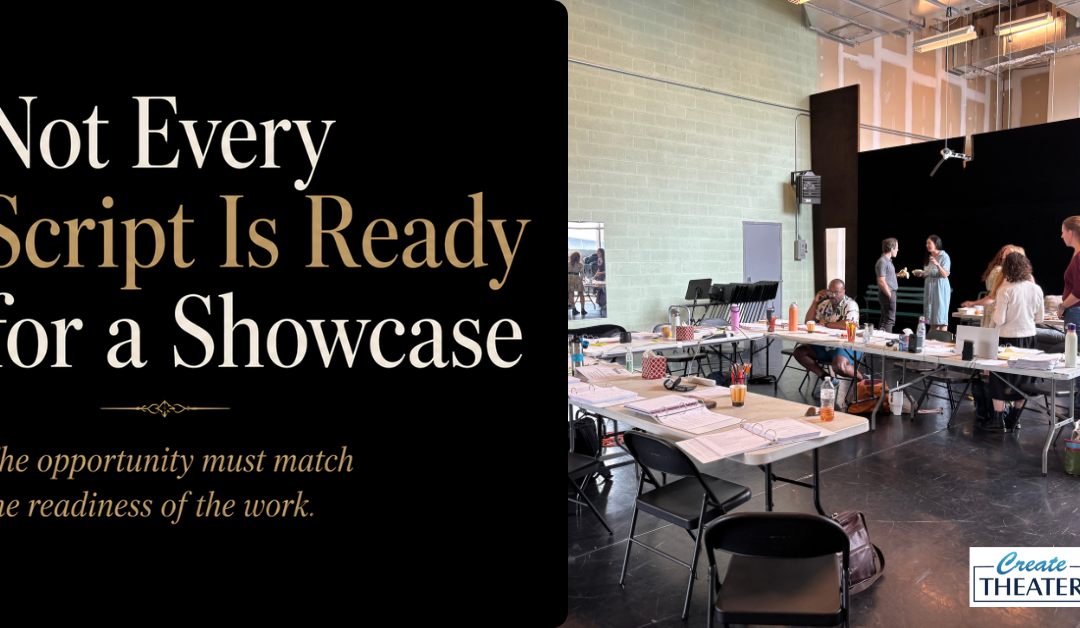
Not Every Script is Ready for a Showcase

Not Every Script is Ready for a Showcase


There is a moment in the development of a new play or musical when the writer begins to ask a very understandable question:

When can I get this in front of industry?

Maybe the script has had a few readings. Maybe it has been through a writing group. Maybe the writer has spent months—or years—rewriting it. At some point, the natural impulse is to move outward: invite producers, artistic directors, literary managers, directors, investors.

In other words: showcase it.

But here is something I have become increasingly clear about as a producer:

Not every script is ready for a showcase.

And that is not a judgment on the quality of the writer or even the potential of the work.

It is a question of timing.


A Showcase Creates Expectations

The word showcase can sound deceptively casual.

We sometimes treat it as simply another developmental step: first a reading, then a workshop, then a showcase.

But a showcase is different because the purpose of the room changes.

A developmental reading asks:

What does the piece need?

A showcase begins asking:

What could happen to this piece next?

That distinction matters.

Once you invite industry professionals into the room, you are asking them to begin imagining the work beyond development.

Could this fit our season?

Would I produce this?

Would I direct this?

Could I introduce this writer to someone?

Is there an audience for this?

What would it cost?

That means the work is being evaluated differently.

And you want the script to be strong enough to benefit from that attention.


More Exposure Is Not Always Better

Writers are understandably encouraged to get their work seen.

And yes—new work needs advocates.

But there is a difference between getting the work seen and getting the work seen at the right moment.

Premature exposure can work against you.

If an artistic director sees a script before its central dramatic problem has been solved, they may simply conclude that the script does not work.

They may never know that six months later the writer completely restructured Act Two.

If a producer watches a musical before the score, book, and dramatic architecture are working together, they may remember the weaknesses rather than the potential.

You rarely get to control when someone will encounter your work again.

That is why I do not believe showcases should be consolation prizes, graduation ceremonies, or automatic benefits of belonging to a development program.

They are strategic opportunities.

And strategy requires asking whether the work is actually ready.


So What Does “Ready” Mean?

It does not mean perfect.

There is no such thing as a finished new play or musical that will never change again.

Even productions continue teaching us about the work.

But before I would want to put a piece into an industry-facing showcase, I would want to see several things happening.

The dramatic engine of the piece should be clear.

The audience should understand whose story they are following, what that person wants, and what stands in the way.

The structure should basically hold.

There may still be cuts, rewrites, new songs, scene changes, and discoveries ahead. But the piece should no longer be searching for its fundamental architecture.

The major emotional turns should land.

The writer should have already heard the work aloud—preferably more than once—and made discoveries from actors and audiences.

And perhaps most importantly:

We should know why we are doing the showcase.

“Because I want industry people to see it” is not quite enough.

  • Which industry people?
  • And what do you want them to do next?
  • Are you looking for a producing partner?
  • A regional theater?
  • A commercial producer?
  • A director?
  • A developmental residency?
  • Investors?
  • An artistic home?

The clearer the next objective is, the more useful the showcase becomes.


Sometimes the Best Next Step Is More Development

This is the part writers sometimes find frustrating.

They have worked hard. They are eager to move forward.

And then the producer says:

I think we need another reading.

Or another rewrite.

Or a workshop.

That can feel like standing still – and possibly make you angry.

But development is not standing still when it is answering a specific question.

A table reading might reveal whether the storytelling is clear.

A music rehearsal might expose a structural problem in a musical.

A staged workshop can tell us whether transitions, pacing, physical storytelling, and theatrical moments are functioning.

Each form of development gives us different information.

The goal is not to accumulate development credits.

The goal is to solve the problems that stand between the work and its next opportunity.


This Is How I’m Thinking About CreateTheater’s 2027 Showcases

We are beginning to look toward CreateTheater’s 2027 Showcase productions (as well as our 2027 New Works Reading Festival).

But regarding the showcases, my question is not simply:

Which writers deserve an opportunity?

There are many writers I believe in.

My question is:

Which projects are ready for this particular opportunity?

Those are not the same thing.

One project may be ready for a showcase.

Another may need six more months of focused development.

Another may need a table reading before anyone makes that decision.

Another may actually be ready to move beyond a showcase toward production conversations.

That is the kind of pipeline that CreateTheater has built.

Not a conveyor belt where every project automatically advances to the same next step.

A developmental process in which the opportunity matches the readiness of the work.

Because the goal is not simply to present a script.

The goal is to help that script move forward.


The Better Question

So if you are developing a new play or musical, I would encourage you to replace:

“How do I get a showcase?”

with:

“What does my work need next?”

Sometimes the answer will be a showcase.

Sometimes it will be another reading.

Sometimes it will be a workshop.

Sometimes it will be a serious rewrite.

None of those answers mean you are behind.

They mean you are developing the work strategically.

And when the right opportunity finally arrives, you want the piece to be ready to take advantage of it.

Because in new work development, the opportunity must match the readiness of the work.

(NOTE: Image is from the first day of rehearsal for the next musical LITTLE THINGS by David H. Smith at the Philadelphia Theater Company.)


Want to follow how CreateTheater develops new plays and musicals toward readings, workshops, showcases, and production? Join the CreateTheater newsletter and come inside the development room.

Come join us at the Philadelphia Theater Company for LITTLE THINGS on August 29th at 3pm

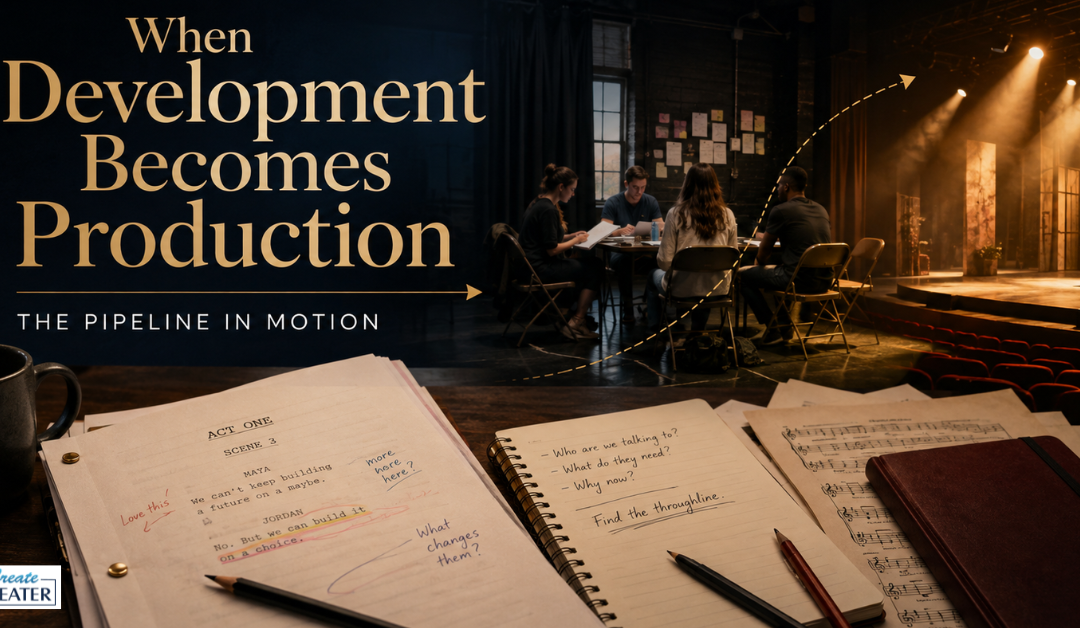
When Development Becomes Production

When Development Becomes Production

The Pipeline in Motion

I’m writing this from Philadelphia, where I’ll be in rehearsal for a few days with LITTLE THINGS at the Philadelphia Theatre Company.

And looking at the week ahead, I realized that this may be one of the clearest examples I’ve had of what I mean when I talk about a development pipeline.

Because this week, CreateTheater has work happening at nearly every point along it.

On Monday night, we’ll hold another Monday Night Developmental Reading—this time Act One of a new musical by ETC member Jarlath Jacobs, currently living in Italy. The working title is JACQUES & JILL, a reworking of her musical FIRE ISLAND, which had a showcase production at Theatre Row as part of the CreateTheater New Works Festival in 2022.

That project has already been produced once.

And now it is back in development.

Because development is not a straight line, and production is not always the end of the process.


Production Is Not the End of Development

There is a tendency to imagine a theater project moving along a neat, linear path:

Write the show → develop the show → produce the show → done.

But that is almost never how new theater actually works.

A reading reveals one thing.
A workshop reveals another.
A showcase reveals something else entirely.

Sometimes a production tells a writer that the piece is finished.

Sometimes it tells them exactly where the next version needs to begin.

That is what development is for.

Our Monday Night Developmental Readings have been running all summer, and we are now booked every Monday through December with readings of new plays and musicals. Some are early drafts. Others have already had significant development or production experience.

The point isn’t that every reading immediately leads to a production.

The point is that the work keeps moving.


Tuesday: Back in the Development Room

On Tuesday, after a day in rehearsal in Philadelphia, I’ll run two ETC writing groups which meet over Zoom to continue developing new plays and musicals.

This is quieter work.

There are no costumes. No lighting cues. No ticket buyers.

It can be easy to look at this stage and think that the “real” theater hasn’t begun yet.

But this is where much of the real theater work gets done.

Characters are clarified. Structures are challenged. Songs are moved. Scenes disappear. Endings change. Writers hear pages aloud and discover that something they thought was perfectly clear on the page isn’t clear at all when actors speak it.

Those decisions may eventually determine whether a producer can see a viable production in the work.

Which brings us to Wednesday.


Wednesday: Development Becomes Production

On Wednesday, we will officially announce THE BLUE VIOLINIST OVER WEST END AVENUE Off-Broadway.

Tickets will go on sale.

Previews begin October 27.

That is the moment outsiders can see.

The announcement.
The theater.
The dates.
The tickets.

It looks like production has begun.

But from where I’m sitting, production began a year earlier.

It began in the conversations with playwright Debbie Goodstein about what the play wanted to become.

It continued through readings, rewrites, artistic conversations, assembling a producing team, hiring (and firing) collaborators and making the hundreds of decisions required before anyone ever walks into a rehearsal room.

And, importantly, the development still isn’t over.

On Thursday afternoon, Debbie, director Jonathon Silverstein, and I will spend several hours together hearing the newest draft of the play—just the three of us. On Zoom, because it’s summer and we’re not all in Manhattan.

No audience.

No presentation.

No attempt to make it look finished. But the work continues.

We are still listening.

Still asking questions.

Still making sure the script we take into rehearsal at the end off September is the strongest version of the play we know how to make right now.

That is what I think writers sometimes misunderstand about the moment when development turns into production:

You don’t stop developing because you have a production.

The questions simply change.


The Questions Change

During early development, we might ask:

Is the story clear?
What does this character want?
Is this scene earning its place?
Where does Act One actually end?

Once production approaches, those questions begin intersecting with others:

How will this world physically exist onstage?
What kind of actor does this role require?
What does the audience need to understand visually?
What can we afford?
What must we protect artistically?
What has to be decided now?

By Friday, we’ll be in another production meeting for The Blue Violinist, approving final designs for the set, lights and costumes. We’re hoping to have casting complete by the beginning of the following week.

Those are unmistakably production decisions.

Yet they are still serving exactly the same thing we were serving in the development room: the story.

And Meanwhile, More Work Is Moving Forward

Thursday evening, we’ll shift gears again and continue to plan the three CreateTheater Showcases we’re producing in 2027.

Friday evening, we’ll turn toward the November New Works Cabaret Festival.

And here in Philadelphia, LITTLE THINGS is entering a different stage of the same journey.

The show has already gone through development with CreateTheater, including a cabaret presentation last year. Now the writers have the opportunity to put more of it on its feet and discover what happens when actors, staging, choreography, music and an audience become part of the equation.

That workshop will give us information we could never find sitting around a table.

And whatever we learn will feed the next stage.


So When Does Development Become Production?

I’m not sure there is one clean line.

I think there is a period when the center of gravity shifts.

At first, the primary question is:

What is this show?

Eventually, the question becomes:

How are we going to make this show happen?

And somewhere in between, the producer begins committing resources, collaborators, space, money, time and reputation to the answer.

That is when development starts becoming production.

But development itself never completely disappears.

At least, I don’t think it should.

A healthy new-work pipeline isn’t a conveyor belt that moves a script from one box to the next.

It is a continuing artistic process in which each new stage gives us more information.

Reading → workshop → showcase → production → perhaps development again.

The goal is not simply to “get the show produced.”

The goal is to make the strongest show we can—and to understand what the work needs next.

Looking at the week ahead—readings, writing groups, rehearsal, an Off-Broadway announcement, a script session, design approvals, showcase planning and a cabaret festival—it feels less like a collection of separate activities and more like one continuous act of making new theater.

And that is exactly what I had always hoped CreateTheater would be.

A place where new work keeps moving toward the stage.

Come join us at the Philadelphia Theater Company for LITTLE THINGS on August 29th at 3pm