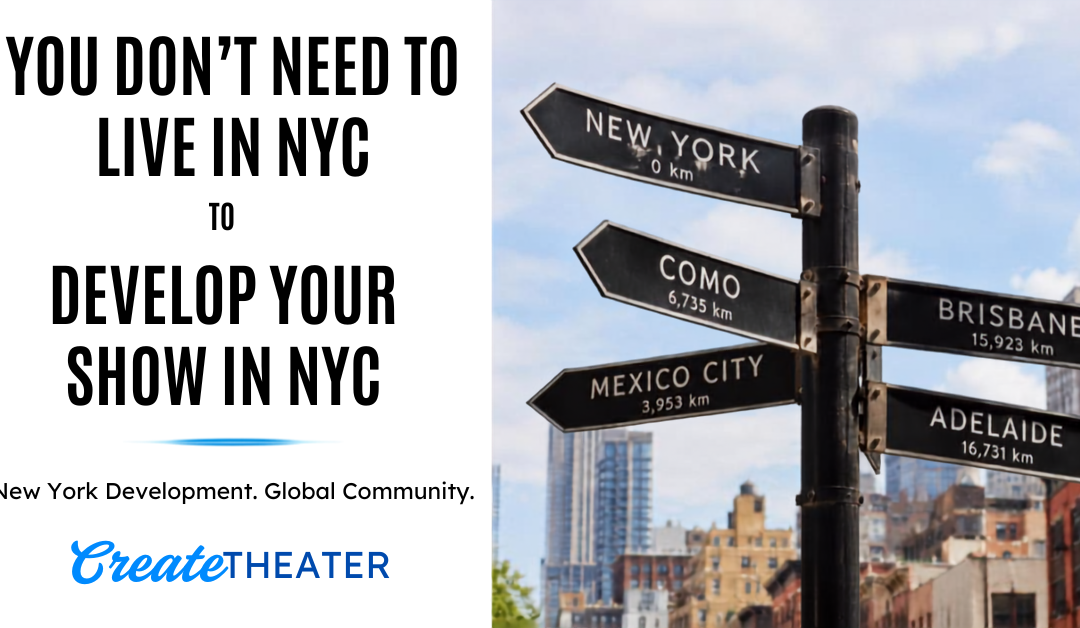
You Don’t Have to Live in NYC to Develop Your Work in NYC.
New York Development. Global Community.
One of the things I find myself thinking about more and more is geography.
For a long time, most serious theater development was tied to New York. If you wanted to develop a new musical professionally, the assumption was that you needed to be here — physically here in NYC — within reach of the rehearsal rooms, the readings, the writers’ groups, the industry conversations, and the people, in order to be successful.
That is no longer completely true.
Geography no longer has to limit access to a professional development process.
You don’t have to live near New York to develop your work in New York.
At least in the beginning.
CreateTheater is not an online education company. ETC is not simply a collection of Zoom classes. What we do is make it possible for serious writers, wherever they live, to develop their scripts while remaining connected to a professional New York theater development process.
The Experts Theater Company — ETC, our Theater Residency program within CreateTheater — attracts writers from all over the world because they can belong to a NYC-based professional theater company that is actively developing their work without having to move to one of the most expensive cities in the world.
That is a very different proposition from taking an online class.
It means becoming part of an ongoing professional artistic community.
Our Writers Live Across the Globe
Jarlath Jacobs lives in Como, Italy. She is continuing to develop JACQUES AND JILL with us after we produced an earlier version in 2022. She returned to the work because she wanted to make significant changes to the story — and ETC gave her a community that already knew the musical and could help her rediscover it.
Wendy Bichel joins us from Mexico.
Mark Sherry works with us from Brisbane, Australia.
The geography is different, but the artistic conversation remains centered in New York: professional development standards, industry expectations, production readiness, readings, workshops, and the larger question of how a project moves toward presentation and production.
And the community matters just as much as the artistic work.
That became especially clear to me when Michael Riggs, one of our writers from Adelaide, Australia, came to New York for a visit.
By the time he arrived, he already knew so many people through ETC that he didn’t feel as if he were arriving in a strange city and starting from scratch.
He had a whole circle of friends waiting for him.
We ended up throwing him a party at citizenM in Times Square.
And I remember thinking:
This is part of what we have built.
Not just a program.
Not just a series of readings.
A professional artistic community that exists across geography — and becomes very real when people finally find themselves in the same room.
Theater Artists Need More Than Feedback
I knew even before the pandemic that writers needed more than notes.
They needed continuity.
They needed people who knew the work over time, who could remember what the previous draft was trying to solve, and who could say:
“Yes, this scene is stronger — but now you have to clean up the opening number, because this changes it.”
That kind of feedback is different because it comes from people who understand the larger developmental journey.
Writers need to know what their next question actually is.
They need colleagues who show up for their readings.
And they need an artistic community they can trust.
That sense of belonging is a huge part of ETC.
If you are writing a musical in Brisbane, Como, Mexico, or somewhere else entirely, you may have excellent local collaborators. But you may still want to remain connected to the New York theater ecosystem — not because New York is the only place where theater matters, but because it remains an important professional marketplace and development center for new work.
Technology simply makes it possible to stay in that conversation.
It expands the room.
What it does not do is remove the need for standards.
Professional Development — Through Zoom?
A Zoom room is not automatically a professional development room.
A reading is not valuable simply because people showed up to read it.
A workshop is not useful simply because someone gave you notes.
The value comes from the rigor and professionalism of the process.
Who is in the room?
How experienced are they in developing new musicals or plays?
What question are you trying to answer?
What happens after the reading?
Does the writer understand what needs to change?
Does the writer understand what the next step should be?
Can the writer trust the feedback?
These are the same questions I would ask if the creative team were sitting around a table on 42nd Street at the West Bank Cafe after a reading instead of talking on Zoom.
It matters who is in the room.
The geography has changed.
The artistic expectations have not.
The digital room can also strengthen the development process because writers do not have to wait until they can afford to fly to New York, rent housing, and organize an entire trip just to keep the work moving.
They can continue developing the script at home while staying inside a professional process.
Then, when the project reaches the point where it truly needs bodies in a physical room — staging, choreography, design, audience response, production rhythm — we make that happen here in New York.
“Zoom Theater” Will Never Replace Live Theater
Online development is not a replacement for live theater.
It is a way to get the work ready for the moment when live development becomes necessary.
There are questions you can answer around a virtual table.
There are questions you can only answer when actors step into the roles in a physical room.
And there are questions you cannot answer until an audience is sitting in front of you.
For some work — especially scripts that depend heavily on physical comedy, choreography, staging, or a particular performer’s relationship with an audience — Zoom has obvious limits.
Online development is not right for every project.
But eventually, every script needs to meet an audience.
A creative producer’s job — and an artistic director’s job — is to know what each project needs next.
The writer may be in Brisbane, Como, Mexico City, or Manhattan. What matters is the rigor of the process, the quality of the artistic conversation, and the people who stay with the work over time.
Because serious work still needs a serious room, with experienced people in it.
And serious artists need an artistic home.
That is what we have built in ETC.
I am deeply proud of this company and of the talented theater artists around the world who make it what it is.
You don’t have to live in New York to develop your work in New York anymore.
But you do need a community that knows the work and can help you move it forward.