Most theater projects do not stall because the work isn’t good.
They stall because development is so difficult to sustain.
A playwright begins with excitement. A composer starts hearing the score. A collaborative team gathers around an idea that feels urgent and alive.
Then, slowly, the momentum fades.
The reading happens. Feedback comes in. People say encouraging things.
And then…
Nothing.
No next step. No developmental strategy. No producing support. No sustained artistic ecosystem to mentor the work forward.
The project enters the place where many promising theater works disappear: developmental limbo.
The Isolation Problem
Many writers spend years developing work in isolation.
Not because they want to — but because the structure of the contemporary theater industry often leaves them there.
Theater is inherently collaborative, but development has increasingly become private.
Writers revise alone. Submit alone. Network alone. Attempt to produce alone.
Without sustained collaboration, it becomes difficult to maintain clarity about the work itself.
Questions begin to accumulate:
Is this working?
What audience is this really for?
What changes should I make?
Is the problem structural or is it something else?
Is this project producible?
Should I keep going with this project?
Without artistic guidance, revisions can become circular rather than forward-moving.
Many writers are not actually revising the script anymore. They are revising to please someone else.
Feedback Is Not the Same Thing as Development
One of the biggest misconceptions in new work creation is the idea that feedback alone = development.
But receiving opinions is not the same thing as building a show.
A playwright may receive:
script notes
workshop responses
reactions from peers
coverage
dramaturgical comments
But unless someone is helping shape a long-term developmental process, the work can still stall.
Real development requires:
continuity
momentum
leadership
collaboration
producing awareness
audience understanding
artistic accountability
In other words: development is not just about rewriting pages.
It is about sustaining movement.
Momentum Is the Most Important Resource
The greatest threat to new theatrical work is not failure.
It is inertia.
A project loses momentum when:
there are no deadlines
no collaborators
no producing pathway
no developmental milestones
no audience engagement
no ecosystem carrying the work forward
And momentum matters because theater is not created with just one one step.
The strongest projects evolve through sustained interaction between:
writers
directors
dramaturgs
performers
producers
audiences
Without movement, even strong projects begin to psychologically disappear for the artists creating them.
Theater history is filled with extraordinary unfinished, unproduced, or abandoned work — not because the stories lacked value, but because development requires infrastructure.
And infrastructure is expen$ive.
The Economics of Development
There are more good stories than the theater industry currently has the capacity to produce.
That is the reality every developmental company confronts.
The cost of producing theater right now – anywhere – is extraordinarily high. Institutional risk is real. Commercial production requires enormous capital. Nonprofit theaters operate with limited resources and shrinking margins.
Which means many worthy projects never receive any sustained developmental investment.
This is why artistic support matters so deeply.
Not every project will receive a full production immediately.
But every artist deserves:
serious development
collaboration
momentum
community
producing literacy
audience connection
a pathway forward
What Development Could Be
At its best, theatrical development is not simply script improvement.
It is the creation of conditions where artists and projects can continue evolving toward audiences.
That requires more than workshops.
It requires sustained ecosystems supporting new theatre.
Spaces where:
writers build long-term relationships
producers engage early
dramaturgy provides strategy
projects are developed sustainably
momentum is protected
artists are not isolated
This is our philosophy behind CreateTheater’s development programs.
We believe new work deserves:
sustained artistic support
collaborative infrastructure
dramaturgical guidance
producing insight
and meaningful pathways toward presentation
Because while not every project can immediately move to full production, every serious artist deserves the opportunity to continue growing their work in community.
Developing the Work in Community
Theater does not move forward in isolation, alone.
It moves forward through sustained development, collaboration, and momentum.
At CreateTheater we’re working toward helping develop the work and then, when it’s ready, creating the pathways forward. Collaboratively.
At CreateTheater, we believe development should lead somewhere.
Our flagship programs are built around long-term artistic growth, dramaturgical support, and industry presentations & productions.
This month, we’re launching:
The 12-Month Musical Writing Lab
The 12-Month NYC Producer Lab
The Off-Broadway Producer Intensive
If you’re ready to move your project forward, make sure you sign up before the end of June.
You’ve revised the script. You’ve gotten feedback. Maybe you’ve even done a reading.
And then…
Nothing.
No momentum. No next step. No production. No real traction.
So you start wondering if the problem is the industry. Or the timing. Or whether theater is just impossible right now.
But after years working with new plays and musicals in New York, I can tell you something difficult — and liberating:
Most scripts don’t stall because the writer isn’t talented.
They stall because the work isn’t yet producible.
And those are two very different things.
A lot of writers are creating plays as literary documents.
But theater isn’t literature.
Theater is a live event that requires: actors, directors, designers, producers, money, space, audience buy-in, and a reason to exist right now.
That doesn’t mean your work has to be commercial. It doesn’t mean it has to be safe. And it definitely doesn’t mean you should write to trends.
But it does mean your script has to understand the realities of production.
Can a director envision this onstage? Can actors emotionally land inside it? Can an audience track the dramatic engine? Does the structure create momentum? Does the play know what experience it’s trying to create in the room?
These are producing questions. And they are creative questions.
I think this is the missing conversation in a lot of playwright education.
Writers are taught how to write scenes. But not how to build theatrical experiences people want to champion.
And honestly? That’s where careers begin to shift.
Because once your work becomes producible, people can suddenly move with it.
Producers lean in. Directors see possibilities. Collaborators want to attach themselves. Readings lead to workshops. Workshops lead to productions.
Momentum becomes easier because the work itself generates momentum.
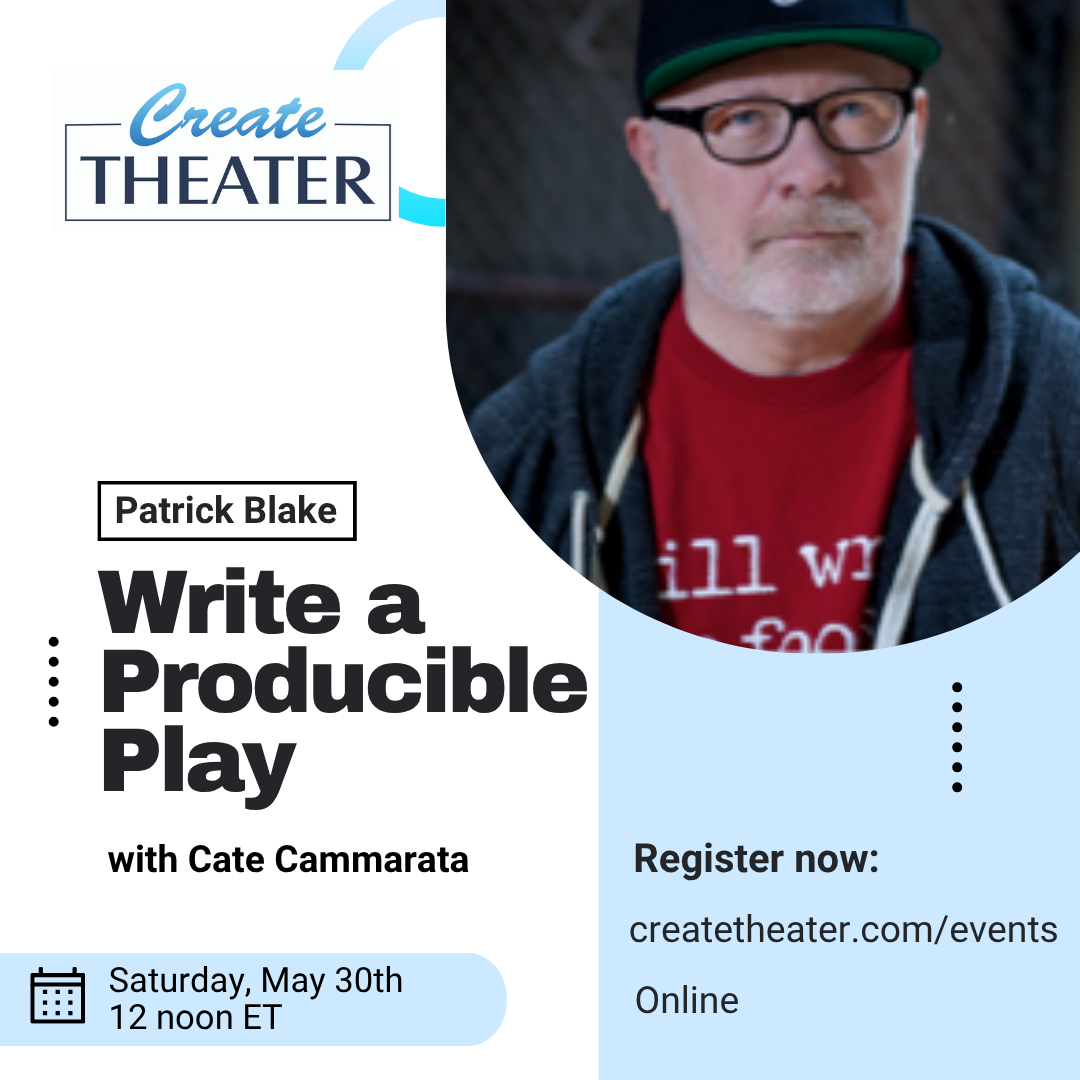
This week, I’m teaching a free webinar called Write a Producible Play because I think too many talented writers are stuck in development limbo without understanding why.
We’re going to talk about:
why some plays move forward while others stall
the structural mistakes that quietly kill momentum
how producers evaluate new work
and how to develop your script with production in mind without sacrificing your artistic voice
Because your play does not need to become smaller.
It needs to become stage-ready.
And those are not the same thing.
If your work has felt stuck lately, this webinar is for you.
If this opened your eyes to how producers actually evaluate your script…
Then you’ll want to be in the room for our live training:
Write a Producible Play Webinar on May 30th
Off-Broadway Producer Patrick Blake and I will walk you through exactly how to check your work so it’s not just compelling, but something a producer can get on board with.
Stay True to Yourself (Or Watch Your Play Disappear)
I’ve been telling our writers something over and over the past few weeks:
Stay true to yourself.
Yes, it sounds generic. It’s not.
I mean it in a very specific way: knowing exactly where your play lands.
Playwrights—especially early and mid-career—are hungry to be produced. And because of that, they become incredibly good at working with notes. They implement changes quickly. They listen closely. They adjust to make the play better.
Especially when the notes are coming from a “successful” director.
And that’s where things can go wrong.
Because in the middle of rewrites, it’s very easy for a writer to lose their way.
And once they lose it—they don’t always get it back.
Let me exlain.
The Mistake That Kills Good Plays
Here’s what just happened:
We had a writer who had done the work. Months of development. The script was strong. Funding was in place. A venue was secured.
We brought in a highly recommended director. Enthusiastic. Experienced. Seemed like the right fit.
At first, everything looked good.
Then we scheduled a table read—because after major rewrites, you have to hear the piece out loud.
What we heard wasn’t the writer’s play.
It was the director’s.
The original piece was about a family navigating grief, disconnection, and misunderstanding.
The new version? A political debate.
Same characters. Same structure. Completely different play.
And here’s the part no one wants to say out loud:
If that version had gone forward and succeeded—it wouldn’t have been the writer’s success.
It would have belonged to the director.
Fortunately, we hadn’t signed the contract yet.
What This Cost (And What It Taught Us)
This wasn’t just creatively frustrating—it was expensive. Time, energy, momentum.
But it clarified three non-negotiables:
1. Stop trying to please the room. If you’re making changes to keep a director or producer happy, you’ve already started drifting.
2. Know what you want your audience to walk away with. Not your “message.” Your impact.
What should they understand, feel, or question when the lights come up? What do you want them to think about on the way home?
If you can’t answer that clearly, someone else will answer it for you—and rewrite your play in the process.
3. Choose your director like it matters—because it does. Never go with the first “yes.”
Talk to multiple directors. Ask them one simple question: “What is this play about at the end?”
If their answer doesn’t match yours, they are not your director. Full stop.
Don’t Become the Wrong Kind of Playwright
Let’s be clear:
I am not telling you to become the “resistant playwright” everyone dreads working with.
Collaboration is essential.
But there’s a difference between collaboration and compliance.
If you’re so open that your play can become something different… it will.
And then it no longer is yours.
The Line You Cannot Cross
You can take notes. You can explore alternatives. You can rewrite entire sections.
But you cannot lose sight of why you wrote the play in the first place.
Because once that’s gone—
You’re no longer developing your work.
You’re developing someone else’s.
And that is a much more expensive mistake than you think.
Ready to Develop Your Work Without Losing Your Voice?
This is exactly why we built our development pipeline at CreateTheater.
Because getting your work “ready” isn’t about collecting opinions—it’s about strengthening your voice so it can stand up in the room.
Inside our development programs, you’ll learn how to:
Take notes without losing your core idea
Clarify what your play is actually about
Collaborate with directors from a position of strength—not insecurity
Get your work to a place where it’s ready to be seen as you intended it
If you’re serious about developing your play or musical the right way: