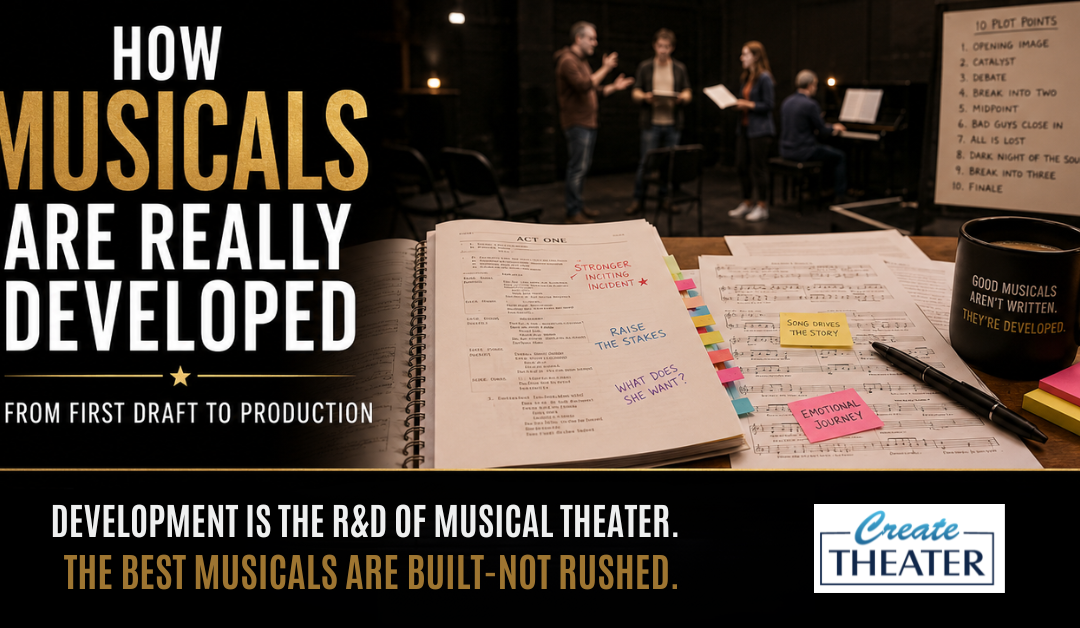
How Musicals Are Really Developed

How Musicals Are Really Developed

From First Draft to Production

If you are writing a musical, you may be wondering: How does a musical actually get developed?

The answer is not usually: write the first draft, find a producer, and go straight into production.

Professional musical theater development is a process.

I know this not only as a teacher and producer, but from more than 16 years of working directly with new musicals as a dramaturg, director, and producer.

I have used my dramaturgical toolkit to develop new musicals through Porchlight Music Theatre in Chicago and Rhymes Over Beats Hip Hop Theater Company in New York City. I have directed industry readings and developmental presentations. I have workshopped a new musical at The Duke on 42nd Street and then produced that musical at Bay Street Theater.

And through my work with musical theater teams at CreateTheater, I have helped develop dozens of new musicals—projects that have gone on to productions in New York City, regional theater productions, recorded musical productions, and projects later presented through Streaming Musicals.

The process is different for every musical.

But the fundamental truth remains the same:

A musical is developed.

Musical Theater Development Is the R&D Process

A new musical may take seven to ten years—or more—to develop before it reaches a major production.

During that time, the musical may go through readings, workshops, cabarets, industry presentations, showcases, regional productions, and multiple rewrites.

That is not a sign that the musical is failing.

That is how musicals are developed.

I think of musical theater development as the R&D phase of creating a new musical.

Before a technology company releases a product, it tests, revises, and improves it. A musical needs a similar process.

Development allows writers and creative teams to discover:

  • Does the story work theatrically?

  • Is the central conflict strong enough?

  • Do the characters drive the action?

  • Are the songs advancing the story?

  • Does the structure create momentum?

  • Where does the audience lose interest?

  • What does the musical need to become production-ready?

The goal is not simply to make a musical “better.”

The goal is to discover what the musical actually needs.


Structure Is the Foundation of a Musical

One of the most important parts of developing a new musical is understanding musical theater structure.

Over the years, my work as a dramaturg has given me a practical toolkit for identifying where a musical is working—and where the story is asking for something different.

At CreateTheater, I teach writers to work with the 10 Plot Points of Musical Theater Structure.

These plot points provide a framework for understanding how a musical moves from its opening world through disruption, escalating conflict, obstacles, the Act One Finale, the midpoint, the crisis, and the resolution.

This does not mean every musical must follow a rigid formula.

It means the writer needs to understand the dramatic architecture of the piece.

A musical can be unconventional. It can be nonlinear. It can break structural rules.

But the writer needs to know what the audience is experiencing at every stage—and why.


Development Happens in Stages

A musical is not developed through one workshop and a single set of notes.

Different developmental opportunities answer different questions.

An industry reading can reveal how the story, characters, and songs function when experienced by an audience.

As a director of industry readings, I have seen how quickly a reading can expose problems that may not be apparent on the page. A scene that seems clear in a script may become confusing when actors perform it. A song that appears to move the story forward may suddenly reveal that it is repeating information the audience already understands.

That information is valuable.

A cabaret or concert presentation can help test the score, songs, performers, and musical identity of the piece.

A showcase can introduce the musical to producers, directors, investors, theaters, and other industry professionals.

A regional production can reveal what happens when the musical has to function as a complete theatrical experience—with staging, actors, design, pacing, technical elements, and a real audience.

I have experienced this process from multiple sides: as a dramaturg helping shape the work, as a director guiding a developmental presentation, and as a producer helping move a musical from workshop to production.

Each developmental step gives the creative team new information.

That is the point.

A reading is not supposed to be a production.

A cabaret is not supposed to answer every question.

A workshop is not supposed to prove that the musical is finished.

Each stage should help the writers understand what the musical needs next.


Developing a Musical Takes Time

The professional development of a musical is often a long process.

A musical may begin with a concept, a book, a score, or a single song. Over the years, the project may change dramatically.

Songs may be cut.

Characters may be combined.

The opening may be rewritten.

The Act One Finale may be completely reconceived.

The creative team may change.

A new director or dramaturg may identify a problem that the original team could not see.

A regional production may reveal that a scene that worked beautifully in a reading does not work when the entire musical is staged.

That is why development is not simply a series of opportunities to “get your musical seen.”

It is a process of learning.

The question at every stage should be:

What are we trying to learn about this musical?

Professional Feedback and Networking Matter

No musical is developed in isolation.

The musical theater industry is collaborative. Writers need relationships with directors, producers, dramaturgs, music directors, performers, theaters, and other writers.

But networking is not simply about meeting people who might “give you a production.”

It is about building relationships with people who can help you understand the work, the industry, and the next step in the musical’s development.

And the feedback matters.

Over the last 16 years, I have worked with enough new musicals to know that the most useful note is not necessarily the most dramatic note.

Sometimes the problem is a song.

Sometimes the problem is a character.

Sometimes the problem is that the musical is trying to begin too late—or end too early.

Sometimes the problem is structural.

Sometimes the writer is trying to solve a scene when the real problem is that the story has not yet created the necessary conflict.

Professional dramaturgy helps identify the problem underneath the problem.

That is often where the real development begins.


The Question Is Not: “How Do I Get My Musical Produced?”

The question is:

What does my musical need next?

That is the mindset of professional musical theater development.

A new musical does not need to be rushed into production.

It needs to be developed intentionally.

It needs to be tested.

It needs to be rewritten.

It needs to be placed in front of the right collaborators and audiences at the right stages of its development.

And it needs a clear understanding of its structure and dramatic engine.

The musicals I have worked on over the years have taken many different paths. Some have been produced in New York City. Some have gone on to regional theaters. Some have been recorded and later made available through streaming platforms.

There is no single path from the first draft to production.

But there is a process.

And understanding that process gives a musical a much better chance of moving forward.


Continue Developing Your Musical

In our NYC Developmental Workshop #2: Conflict, Obstacles and the Act One Finale, we focus on one of the most important stages of musical theater structure.

How does the conflict escalate?

What obstacles stand in the protagonist’s way?

How do those obstacles become increasingly difficult?

And how does the Act One Finale fundamentally change the trajectory of the story?

If you are writing a musical and want to understand how to develop a stronger, more producible piece of musical theater, join us for the next NYC Developmental Workshop.

Your musical does not need to be rushed into production. It needs to be developed with intention.

Want to apply these structural principles to your own musical? Join NYC Musical Development Workshop #2: Conflict, Obstacles & the Act One Finale.
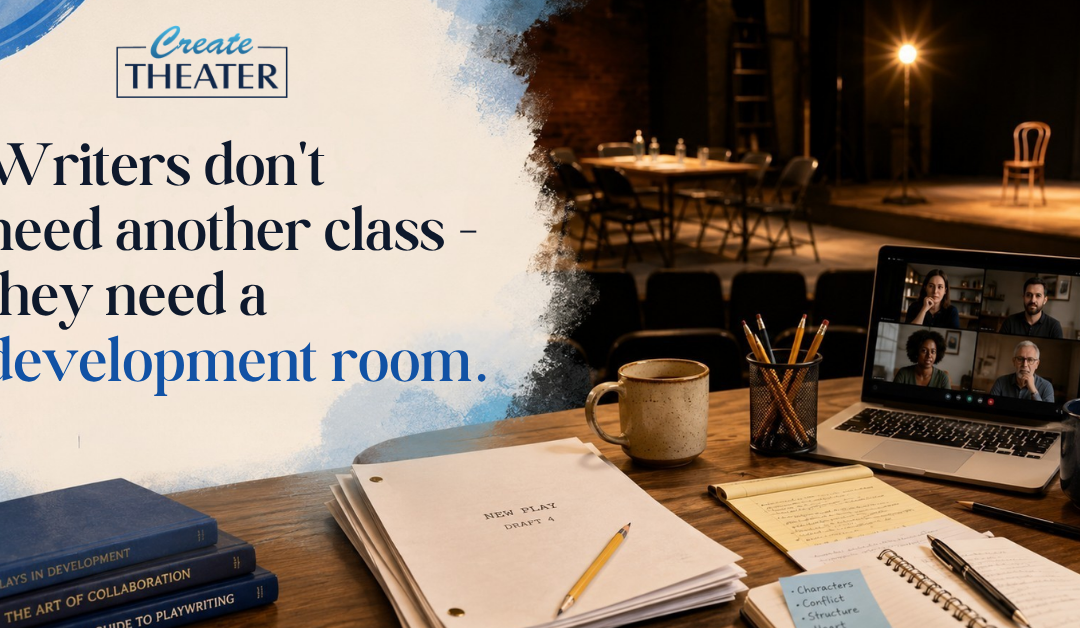
Writers don’t need another class – they need a development room.

Writers don’t need another class – they need a development room.

Sometimes people ask me why I created CreateTheater.

I created CreateTheater because too many writers were trying to develop plays and musicals alone.

They had scripts. They had ideas. They had taken classes.

But they did not have access to the kind of ongoing development room that professional theater requires—especially if they lived outside New York.

CreateTheater was built to become that room online.

I was already developing new plays and musicals online since 2013. Why not turn it into a theater company?

A geographically independent company where writers could bring in their actual work, hear it discussed, receive dramaturgical guidance, and prepare the script for the next stage of development. Not another class. Not generic accountability. A sustained professional artistic process that focused on the play or musical itself, developed by a professional company that happened to be in NYC.

Turns out, this was a really helpful idea! We’re still going strong eleven years later.

But theater cannot live entirely online.

A script may be strengthened on Zoom, but eventually the words must enter the mouths and bodies of actors. Each writer needs to hear the rhythm of the spoken word, feel where the room’s attention shifts, and see what is actually happening in the “audience.”

Theater becomes theater when artists are together in the same space.


Development Reading Workshops

As I’m developing new work post-pandemic, more and more as a professional director/dramaturg we’re exploring the script in one-day or two day reading workshops. It’s an efficient, economical way to engage actors and a director with your script and foster a collaboration of artists for your development process.

That is why CreateTheater is expanding into one-day and two-day development reading workshops in New York City, where most of the casting  process takes place.

The online development room helps the writer prepare the script to enter the live room. Then, in person with actors, a director, and focused dramaturgical support, the work can be tested before the writer spends significant money on a showcase or production.

This is why development matters.

A reading should not simply prove that the script exists. It should reveal what the script needs next.

And the quality of your feedback will either delay your development process or help your script assemble a team that will move it forward faster.

That is why I created CreateTheater: to give writers access to a serious development process, wherever they live – and then bring the strongest work into the room where a professional creative team can make it truly come alive.

I welcome your thoughts and comments!

What is CreateTheater?

What is CreateTheater?

What is CreateTheater? It’s a question I’ve been thinking about a lot lately.

Not because I don’t know the answer, but because I’ve realized that many of the writers in our own community are trying to understand how all of the pieces fit together.

Is CreateTheater a writing group?

A theatre company?

An educational organization?

A festival?

A producer’s lab?

The answer is…

Yes—and no.

Those aren’t separate identities. They’re different expressions of one idea.

As CreateTheater enters its eleventh year, I’ve realized that part of growing as an organization is becoming clearer about who we are—and who we’re becoming.

Why I Originally Founded CreateTheater

When I founded CreateTheater in June 2015, my goal was simple: create a place where new plays and musicals could receive the thoughtful artistic development they deserve.

In 2021, we expanded that vision by launching the Experts Theater Company (ETC), creating an ongoing artistic home where playwrights and musical theatre writers could continue developing their work together. I chose the acronym to honor Ellen Stewart, for her extraordinary contributions to the art of theater at La MaMa Experimental Theater  Club (La MaMa ETC).

In 2022, we presented our first CreateTheater New Works Festival at Theatre Row.

This spring, we celebrated our Fifth Annual CreateTheater New Works Festival, adding The CreateTheater New Works Cabaret Festival in the fall to the mix.

I’m absolutely thrilled that we can grant space in the both of these festivals for artists to present their work – all of it developed in-house in CreateTheater’s writers’ resident company, The Experts Theater Company.

Looking back, I realize that we’ve been building something much larger than a collection of programs.

We’ve been building a developmental theatre company.

Now, with the guidance of our Advisory Board, CreateTheater is beginning the journey toward becoming an independent nonprofit theatre company in NYC dedicated to the development and production of new plays and musicals.

It’s been an awesome journey – and it’s just starting.

But this milestone has prompted me to ask an important question:

What is CreateTheater now, really?

A Developmental Theater Company

Our work is not simply to teach writers how to write. Nor is it only to produce finished plays and musicals.

Our work is to develop new theater.

I believe that’s one of the most important—and often least visible—creative acts in our industry.

When audiences attend opening night, they’re seeing the result of months or years of artistic collaboration. They don’t see the dramaturgical conversations, the table reads, the rewrites, the song that finally finds its place, or the creative breakthroughs that happen because a room full of theatre artists are asking the right questions together.

That’s development.

I believe development is in itself an art form.

Last Friday I was reminded exactly why CreateTheater exists.

I was on a Zoom call with the writers preparing for our next Fall Cabaret Festival.

One team was calling from New York City.

Another from San Francisco.

Another from West Virginia.

Another from New Jersey.

Another from Mexico.

We weren’t taking an online class.

We were doing what theatre artists have always done.

We were solving problems , in the same “room,” together.

Sharing resources.

Offering ideas.

Celebrating breakthroughs.

Helping one another tell stronger stories.

The only difference was that geography wasn’t determining who could be in that room.

Develop Work in NYC from Anywhere

For most of theatre history, access to a professional development process depended on where you lived.

But today, that doesn’t matter.

CreateTheater was formed on Zoom way back in 2015 to bring writers, composers, lyricists, directors, dramaturgs, producers, and collaborators into the same professional development room—regardless of geography.

Not to replace New York.

To extend New York’s collaborative and professional culture.

Because the conversations that happen in New York rehearsal rooms shouldn’t belong only to the people who can afford to live there.

They should belong to every serious theatre artist committed to creating excellent new work.

That’s why our company exists.

Our Programs Form Our Pipeline

The six month Production-Ready Writers Groups are where many writers begin developing their scripts in a collaborative professional environment. 

The 90 day Cabaret Lab gives musical theatre writers the opportunity to hear songs, experiment, and continue shaping their work in front of artists and audiences.

The four NYC Musical Development Workshops each year explore the craft and structure that help musicals become compelling works of theatre.

The year-long Musical Writing Lab and the NYC Producer Lab help selected projects prepare for public presentations in Industry Readings or Showcase productions by bringing together the artistic and practical work required to move from development toward production. Our labs create community, which is the heart of our collaboration.

These aren’t disconnected offerings.

They’re all part of one artistic mission.

To develop professional new plays and musicals through collaboration that result in industry exposure.

To create an artistic home where serious theatre makers can work together and form a community.

And to make New York’s culture of theatrical development more accessible without sacrificing its professional standards.

You no longer have to live in Manhattan to develop and produce your work in Manhattan.

We Develop New Plays and Musicals

At its heart, CreateTheater isn’t built around Zoom.

It’s built around the development room.

A place where artists gather to ask difficult questions, challenge one another with generosity, strengthen each other’s work, and move stories forward to production.

Because great theatre has never been created in isolation.

It has always been created in community.

As we begin this next chapter—growing into a nonprofit theatre company, expanding our artistic partnerships, and continuing to develop and produce new work—our mission feels clearer than ever.

CreateTheater exists to build a community of theatre artists committed to developing professional new plays and musicals through collaboration, dramaturgy, and creative producing.

That has been our work for the past eleven years. And we’re excited for what the next elevent will bring.

Welcome to CreateTheater.

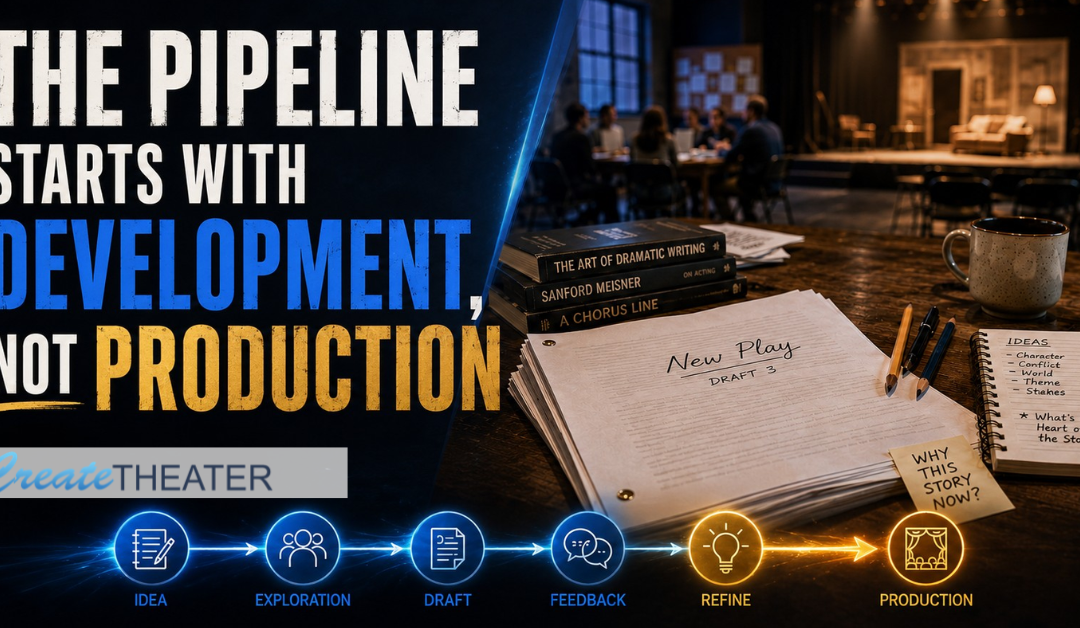
Pipeline Starts with Development, Not Production

Pipeline Starts with Development, Not Production

Everybody wants to get produced.

That is the dream, right?

The lights come up. The actors are in costume. The audience is in the room. Someone has finally said yes. Your play is no longer sitting in a folder on your laptop. It is alive.

I get it.

But after years of developing, directing, and producing new work in New York, I need to say something very plainly:

Production is not where the pipeline starts.

Development is.

And if you try to skip that step, rush through it, or pretend you are “ready” before the work has actually been tested, challenged, deepened, and strengthened, you are taking a much bigger risk than you may realize.

I know I may be preaching to the choir here, but during this summer season I see too many writers spend money on various festivals – and then be disappointed.

Not because they were disappointed with their work – but because they were disappointed that the results they dreamed about didn’t materialize.


The Truth About Festivals

Look, I know theater is tough. But here’s the truth:

Production is expensive.

Audiences are honest.

And industry people have long memories.

A mediocre production of a promising play can do more damage than no production at all.

That may sound harsh.

Good. It should.

Because if you care about your work, you cannot afford to treat development like some annoying little hurdle you have to clear before the “real” thing happens.

You do not want to rush into a “festival production.”

Development is the real thing.

It is where the real work begins.


What Happens When You Produce Your Work Too Soon 

There is a dangerous fantasy floating around among a lot of writers.

It goes something like this:

“If I can just get my show on stage, then everything will change.”

Well … maybe.

But maybe not.

Because getting your show on stage too soon is not always a win.

Sometimes it means the writer had access to money before the play had access to enough development.

Sometimes it means the show got onstage before it knew what it was.

Sometimes it means someone was so eager to make something happen that nobody told them to slow down long enough to ask the harder questions:

  • Is the story actually clear?
  • Does the structure hold?
  • Are the stakes high enough?
  • Does the ending land?
  • Do the characters have enough dramatic agency?
  • Is the audience emotionally tracking the journey?
  • Is this really a producible play — or is it just a strong draft someone really wants to be on stage?

Argh.

How many shows have you seen where you walked away shaking your head and asking, “How on earth did this script get on stage?”

The problems in your script do not magically disappear because you found a venue, hired a director, raised some money, and got your friends to come cheer you on opening night.

In fact, production often makes those problems louder.

Much louder.

Because once the work is in front of an audience, the weaknesses are no longer private.

They are public.

And like I said, the theater industry has a long memory.

A looong memory.

You may never get a second chance to make your show live up to its promise.


Think of Development as Insurance.

I know development can feel frustrating. And it takes so long.

You rewrite the draft.

Then you get notes.

Then you revise.

Then you hear it out loud.

Then you discover the second act has a problem.

Then someone gives you feedback you do not want to hear.

Then a director asks a question that makes you realize the emotional center of the play is not where you thought it was.

Then an audience laughs in the wrong place.

Or worse, they do not respond at all.

And you think:

“Am I ever going to get this play produced?”

I understand that feeling. But development is not punishment.

It is not busywork. And it shouldn’t feel like “developmental hell.”

It is the work. It furthers the work.

Development is insurance.

It is the process that protects the play before you put it under the heat of full production.

It gives you time to hear the work in different ways: with different actors, different directors, different audiences, dramaturgs, producers, and collaborators who can help you see not only what is on the page, but what is actually happening in the room.

That matters. Theatre is a collaborative art.

Because one person’s opinion is not development.

One reading is not development.

One enthusiastic friend telling you “I love it” is not development.

And one industry person giving you a note that sounds smart does not mean you should immediately rebuild your entire play around it.

Development is the process of learning how to listen.

To listen to your play. To listen to the room when your play is being read.

Does it hold the audience?

Or do they get distracted and pull out their phones?

Learn to hear what the work itself is telling you.

That takes time.

It also takes discernment.


CreateTheater Is Development

This is why I created CreateTheater.

Even the name denotes a process.

I didn’t form a theater company to rush writers into production before the work is ready, or to move half-developed scripts into festival showcases.

And I am not here to sell the fantasy that every writer dreams of: seeing their work in front of an enthusiastic audience before the piece is actually ready to meet them.

CreateTheater is a developmental theater company.

We concentrate on the part of the process many people would prefer to skip:

  • The messy middle.
  • The rewriting.
  • The hard questions.
  • The table reads.
  • The feedback.
  • The structure.
  • The audience response.
  • The honest conversation about what is working, what is not working yet, and what the piece needs next.

Because if your goal is to move toward production, the work has to be strong enough to survive production.

That is what a professional development pipeline is designed to do – to carefully learn what your show really needs.


Start Development This Summer

Our Production-Ready Writers™ 6-Month Play Writing Groups begin this week.

If you are serious about developing your play, I’d love for you to consider joining us.

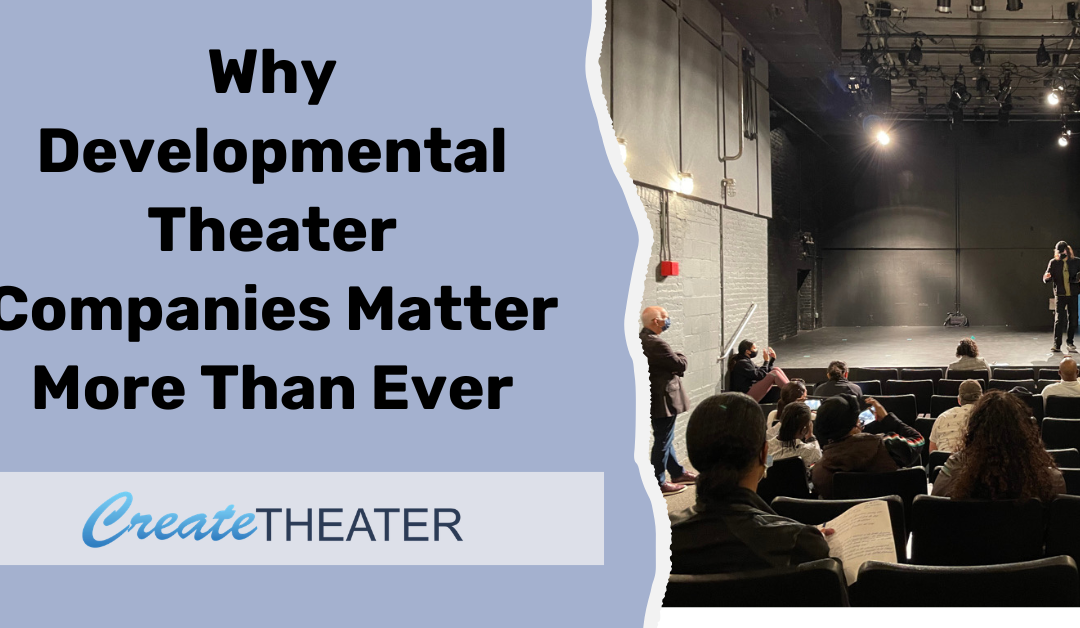
Why Developmental Theater Companies Matter More Than Ever

Why Developmental Theater Companies Matter More Than Ever

Theater is hard right now.

Have you noticed?

It is hard to get produced.
It is hard to get attention.
It is hard to build an audience.
It is hard to raise money.
It is hard to know which opportunity is actually worth your time and which one is just another application fee, another deadline, another “we loved your work but…” email.

And if you are writing a new play or musical, it can feel like you are carrying the whole thing alone.

The script.
The rewrites.
The submissions.
The readings.
The networking.
The hope.
The disappointment.
The question underneath all of it:

How does this piece actually move forward?

That question is exactly why developmental theater companies matter.

And honestly?

They matter now more than ever.


New Work Needs Infrastructure

A play or musical does not move from the writer’s desk to the professional stage by magic.

(I know we love theatrical magic. I believe in it. I have spent my life chasing it.)

But behind that magic is structure.

There is development.
There is dramaturgy.
There is producing strategy.
There is audience response.
There is rewriting.
There is positioning.
There is the hard, sometimes unglamorous work of asking:

  • What is this piece?
  • Who is it for?
  • Why does it matter now?
  • What kind of production is it asking for?
  • What still needs to be solved before anyone can responsibly produce it?

That is not busywork.

That is the work.

And it is the work that too many writers are being asked to figure out by themselves.

A developmental theater company exists to create infrastructure around new work before it is ready for full production. It gives the artist a room, a process, collaborators, professional perspective, and a pathway forward.

Because here’s the truth:

Development is not a luxury. Development is what makes production possible.


New Plays and Musicals Should Not Be Judged Too Early

One of the biggest problems in theater right now is that new work is often expected to behave like a finished product before it has had the chance to become one.

A script gets one reading.

Maybe two.

A few people give notes.

Then suddenly the writer feels pressured to submit it everywhere, pitch it to producers, send it to theaters, raise money, or mount a production before the piece has actually been tested.

That is dangerous.

Not because the writer lacks talent. (Usually, talent is not the problem.)

The problem is that the work has not yet had the developmental support it needs to become theatrically viable – or theatrically exciting.

There is a fragile space between the first strong draft and the production-ready script.

That space matters.

It is where the writer discovers what the story is really about.
It is where the structure either holds or reveals its cracks.
It is where characters deepen.
It is where songs earn their place – or are replaced (or changed).
It is where the audience teaches you what the script is actually doing in the room.
It is where a producer can begin to see the path toward a reading, workshop, showcase, or production.

Developmental theater companies protect that space.

They do not rush past it.

They do not pretend it does not exist.

They honor it.

Because when new work is judged too early, we lose stories that might have become extraordinary with the right support.


Theater Makes Us More Human

I teach college students at Baruch, and one of the things I notice again and again is how accustomed they are to consuming stories on screens.

Film.
Television.
YouTube.
TikTok.
Streaming platforms.
Short clips.
Fast edits.
Endless content.

That is the storytelling world they live in.

So when they come into a theater and experience a live performance — sometimes for the first time in a serious way — they experience storytelling in a different way.

They are watching actual human beings breathe in the same room.

They are sitting with strangers.

They cannot pause it.
They cannot scroll past it.
They cannot double-speed it.
They cannot look away without feeling the weight of their own attention.

And it excites them.

Live theater asks something different of us.

It asks us to be present.

And new work asks something even more urgent. It says:

  • This story is being made now.
  • This conversation belongs to this moment.
  • This room matters.
  • These people matter.
  • This audience matters.

In a digital culture, live theater reminds us that human presence still matters.

And – I deeply believe that seeing theater makes people more human.

Not softer. Not nicer. Not magically transformed by curtain call.

But more aware.

More empathetic.

More awake to the lives of others.

And right now, we need that.


We Need New Stories That Reflect the World We Are Living

Theater has always held a mirror up to society.

But that mirror has to be current.

It has to reflect the people in the room, the questions we are asking now, the communities we live in, the anxieties we are carrying, the joy we are trying to protect, and the human contradictions we are all trying to survive.

That is why new work matters.

And yes, regional theaters are doing important work telling stories rooted in their own communities. They should. That local connection is essential.

But Off-Broadway has historically been one of the great launching platforms for new American theater. It remains a place where new work can gather attention, collaborators, credibility, and momentum before moving into regional productions, commercial opportunities, or other future lives.

New York does not need to be the only place where new work is validated.

But it is still one of the most powerful places where new work can be developed, tested, seen, and taken seriously.

That is part of why CreateTheater exists.

We are here to help new plays and musicals become ready for the rooms they are trying to enter.

Not theoretically ready.

Actually ready.


Writers Should Not Have to Develop Theatrical Work Alone

Let me be very clear about something.

Writing a play or musical is not the same as writing a novel.

A script is not a literary artifact meant to sit beautifully on a page.

It is a blueprint for a live event.

That means at some point, the work has to be tested in the bodies, voices, timing, energy, and presence of actual performers in front of actual people.

A writer can only do so much alone.

At some point, the script needs a room.

It needs ears.
It needs bodies.
It needs pressure.
It needs questions.
It needs an audience.
It needs someone who understands not only story, but production.

That is the difference between writing endlessly and developing intentionally.

A developmental theater company gives writers a place to stop guessing.

Not because anyone can guarantee production.

But because the process can become clearer, smarter, and more strategic.

At CreateTheater, we are not interested in development for the sake of development.

We are interested in development that leads somewhere – that leads to seeing the work on stage, where it belongs.

That is why I use the “Develop-to-Produce” method in my Production-Ready Writers™ writing groups.

Because the goal is not to endlessly workshop your play or musical until everyone is exhausted.

The goal is to understand what the work needs next — and then to prepare it for that next step with intention.


Development Also Builds Audiences

Development is not only for writers.

It is also for audiences.

A developmental theater company can invite people into the process of discovering new work. It can help audiences understand that a reading, workshop, or showcase is not a lesser version of theater.

It is a front-row seat to the birth of something.

That is exciting.

It is especially important for students and emerging theatergoers, who may not be able to afford expensive tickets but can still experience the energy of new work in development.

A developmental showcase can become an entry point.

A reading can become a first encounter.

A new play can become the moment someone realizes theater is not dead, dusty, or irrelevant.

It is alive.

It is happening now.

It is speaking to them.

That is part of the cultural value of a company like CreateTheater.

We are not just developing scripts.

We are developing artists, audiences, and future possibilities for the work.


CreateTheater Is Moving Toward Nonprofit Status

This is also why I am working on turning CreateTheater into a nonprofit.

Because if we believe new work matters, then we have to build structures that support it.

Grants and donors can help make space for new plays and musicals that are not yet commercially obvious, but are artistically and culturally necessary.

They can help us provide developmental opportunities, readings, showcases, student access, artist support, and public programming.

They can help us put quality new work in front of audiences in New York and help regional productions happen.

They can help us create a stronger bridge between the writer’s desk and a story being told onstage.

That bridge is desperately needed.

Because if fewer institutions support new stories, we all lose.

Writers lose.
Audiences lose.
Students lose.
Producers lose.
Theater loses.
The culture loses.

A healthy theater ecosystem needs more than finished productions.

It needs places where new work can grow.


So Where Does Your Work Fit Into This?

If you are a playwright or musical theater writer, this is the question I want you to sit with:

  • Are you still writing in isolation?
  • Are you still submitting the same draft everywhere and hoping someone else will see something special in it?
  • Are you still wondering whether your script is actually ready for a reading, workshop, showcase, or production?
  • Are you still getting feedback but not a real path forward?

Then you may not need another random note session.

You may need a developmental process.

I created the Production-Ready Writers™ 6-Month Writing Groups to help develop plays to get onstage.

This 6-month session is for playwrights who are ready to look at their plays not just as scripts, but as future productions.

We will work on the craft, yes.

But we will also look at the bigger questions:

  • What is the piece becoming?
  • Where does it belong?
  • What kind of audience is it trying to reach?
  • What still needs to be developed before it can move forward?
  • What would make this script more producible?
  • What is the next realistic step?
  • How can I help it get there?

Because the goal is not just to write (and rewrite) pages.

The goal is to build a piece that can live.

Onstage.

In front of people.

With impact.


Why This Matters Now

Theater is tough right now.

No argument.

But that is not a reason to stop making it.

We must get more intentional.

We must build better pathways.

We need to support new work before it disappears in the gap between an artist’s idea and a culture’s next important story.

That is what developmental theater companies do.

That is what CreateTheater is here to do – to help new plays and musicals move from idea to structure, from draft to room, from private hope to public possibility.

Because theater still matters.

Live storytelling still matters.

New work still matters.

If your play or musical has something urgent to say, then it deserves more than wishful thinking.

It deserves development with direction.

The Production-Ready Writers™ 6-Month Play Writing Groups begin in July. (Musical Writing Groups will begin in January.)

If you are ready to stop guessing and start building your work toward its next real step, join us.

Your story deserves a room. It deserves support.

And maybe, just maybe, the culture needs the story only you can tell.