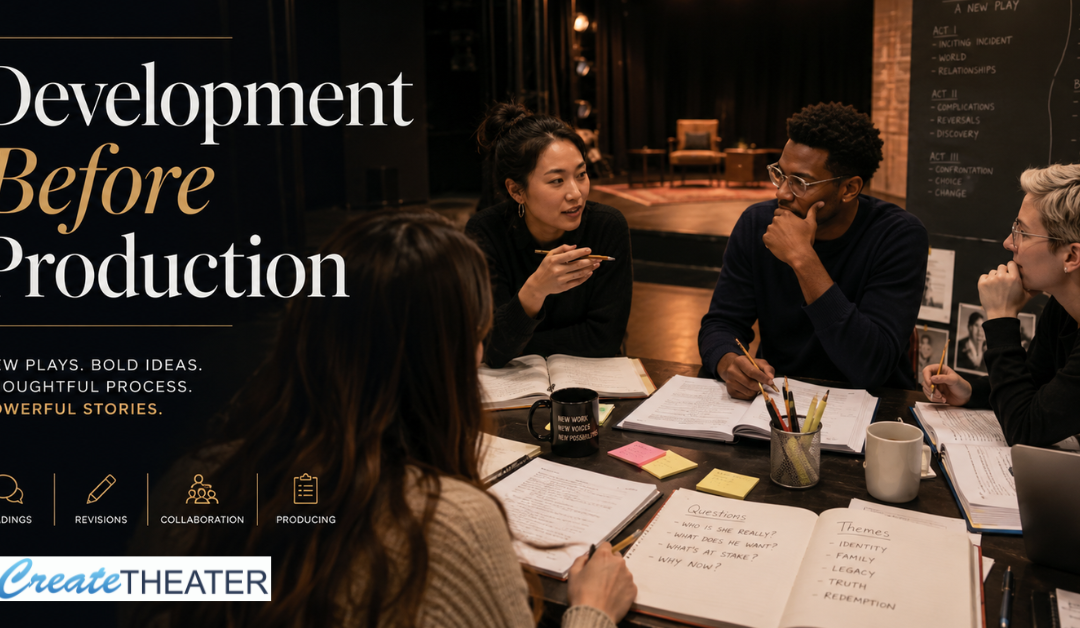
Writers don’t need another class – they need a development room.

Writers don’t need another class – they need a development room.

Sometimes people ask me why I created CreateTheater.

I created CreateTheater because too many writers were trying to develop plays and musicals alone.

They had scripts. They had ideas. They had taken classes.

But they did not have access to the kind of ongoing development room that professional theater requires—especially if they lived outside New York.

CreateTheater was built to become that room online.

I was already developing new plays and musicals online since 2013. Why not turn it into a theater company?

A geographically independent company where writers could bring in their actual work, hear it discussed, receive dramaturgical guidance, and prepare the script for the next stage of development. Not another class. Not generic accountability. A sustained professional artistic process that focused on the play or musical itself, developed by a professional company that happened to be in NYC.

Turns out, this was a really helpful idea! We’re still going strong eleven years later.

But theater cannot live entirely online.

A script may be strengthened on Zoom, but eventually the words must enter the mouths and bodies of actors. Each writer needs to hear the rhythm of the spoken word, feel where the room’s attention shifts, and see what is actually happening in the “audience.”

Theater becomes theater when artists are together in the same space.


Development Reading Workshops

As I’m developing new work post-pandemic, more and more as a professional director/dramaturg we’re exploring the script in one-day or two day reading workshops. It’s an efficient, economical way to engage actors and a director with your script and foster a collaboration of artists for your development process.

That is why CreateTheater is expanding into one-day and two-day development reading workshops in New York City, where most of the casting  process takes place.

The online development room helps the writer prepare the script to enter the live room. Then, in person with actors, a director, and focused dramaturgical support, the work can be tested before the writer spends significant money on a showcase or production.

This is why development matters.

A reading should not simply prove that the script exists. It should reveal what the script needs next.

And the quality of your feedback will either delay your development process or help your script assemble a team that will move it forward faster.

That is why I created CreateTheater: to give writers access to a serious development process, wherever they live – and then bring the strongest work into the room where a professional creative team can make it truly come alive.

I welcome your thoughts and comments!

What is CreateTheater?

What is CreateTheater?

What is CreateTheater? It’s a question I’ve been thinking about a lot lately.

Not because I don’t know the answer, but because I’ve realized that many of the writers in our own community are trying to understand how all of the pieces fit together.

Is CreateTheater a writing group?

A theatre company?

An educational organization?

A festival?

A producer’s lab?

The answer is…

Yes—and no.

Those aren’t separate identities. They’re different expressions of one idea.

As CreateTheater enters its eleventh year, I’ve realized that part of growing as an organization is becoming clearer about who we are—and who we’re becoming.

Why I Originally Founded CreateTheater

When I founded CreateTheater in June 2015, my goal was simple: create a place where new plays and musicals could receive the thoughtful artistic development they deserve.

In 2021, we expanded that vision by launching the Experts Theater Company (ETC), creating an ongoing artistic home where playwrights and musical theatre writers could continue developing their work together. I chose the acronym to honor Ellen Stewart, for her extraordinary contributions to the art of theater at La MaMa Experimental Theater  Club (La MaMa ETC).

In 2022, we presented our first CreateTheater New Works Festival at Theatre Row.

This spring, we celebrated our Fifth Annual CreateTheater New Works Festival, adding The CreateTheater New Works Cabaret Festival in the fall to the mix.

I’m absolutely thrilled that we can grant space in the both of these festivals for artists to present their work – all of it developed in-house in CreateTheater’s writers’ resident company, The Experts Theater Company.

Looking back, I realize that we’ve been building something much larger than a collection of programs.

We’ve been building a developmental theatre company.

Now, with the guidance of our Advisory Board, CreateTheater is beginning the journey toward becoming an independent nonprofit theatre company in NYC dedicated to the development and production of new plays and musicals.

It’s been an awesome journey – and it’s just starting.

But this milestone has prompted me to ask an important question:

What is CreateTheater now, really?

A Developmental Theater Company

Our work is not simply to teach writers how to write. Nor is it only to produce finished plays and musicals.

Our work is to develop new theater.

I believe that’s one of the most important—and often least visible—creative acts in our industry.

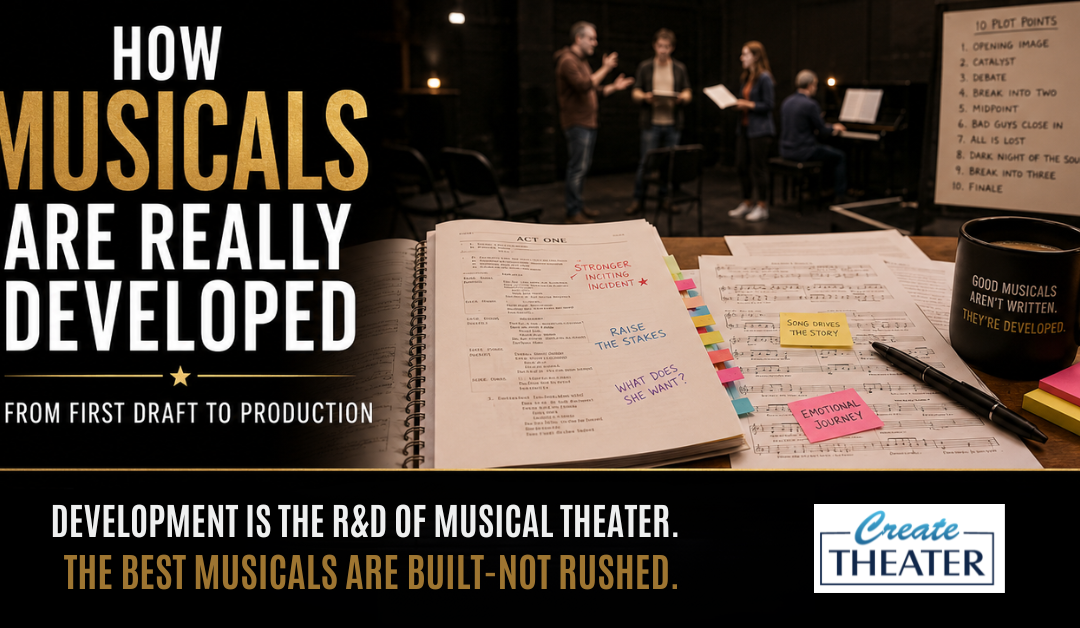
When audiences attend opening night, they’re seeing the result of months or years of artistic collaboration. They don’t see the dramaturgical conversations, the table reads, the rewrites, the song that finally finds its place, or the creative breakthroughs that happen because a room full of theatre artists are asking the right questions together.

That’s development.

I believe development is in itself an art form.

Last Friday I was reminded exactly why CreateTheater exists.

I was on a Zoom call with the writers preparing for our next Fall Cabaret Festival.

One team was calling from New York City.

Another from San Francisco.

Another from West Virginia.

Another from New Jersey.

Another from Mexico.

We weren’t taking an online class.

We were doing what theatre artists have always done.

We were solving problems , in the same “room,” together.

Sharing resources.

Offering ideas.

Celebrating breakthroughs.

Helping one another tell stronger stories.

The only difference was that geography wasn’t determining who could be in that room.

Develop Work in NYC from Anywhere

For most of theatre history, access to a professional development process depended on where you lived.

But today, that doesn’t matter.

CreateTheater was formed on Zoom way back in 2015 to bring writers, composers, lyricists, directors, dramaturgs, producers, and collaborators into the same professional development room—regardless of geography.

Not to replace New York.

To extend New York’s collaborative and professional culture.

Because the conversations that happen in New York rehearsal rooms shouldn’t belong only to the people who can afford to live there.

They should belong to every serious theatre artist committed to creating excellent new work.

That’s why our company exists.

Our Programs Form Our Pipeline

The six month Production-Ready Writers Groups are where many writers begin developing their scripts in a collaborative professional environment. 

The 90 day Cabaret Lab gives musical theatre writers the opportunity to hear songs, experiment, and continue shaping their work in front of artists and audiences.

The four NYC Musical Development Workshops each year explore the craft and structure that help musicals become compelling works of theatre.

The year-long Musical Writing Lab and the NYC Producer Lab help selected projects prepare for public presentations in Industry Readings or Showcase productions by bringing together the artistic and practical work required to move from development toward production. Our labs create community, which is the heart of our collaboration.

These aren’t disconnected offerings.

They’re all part of one artistic mission.

To develop professional new plays and musicals through collaboration that result in industry exposure.

To create an artistic home where serious theatre makers can work together and form a community.

And to make New York’s culture of theatrical development more accessible without sacrificing its professional standards.

You no longer have to live in Manhattan to develop and produce your work in Manhattan.

We Develop New Plays and Musicals

At its heart, CreateTheater isn’t built around Zoom.

It’s built around the development room.

A place where artists gather to ask difficult questions, challenge one another with generosity, strengthen each other’s work, and move stories forward to production.

Because great theatre has never been created in isolation.

It has always been created in community.

As we begin this next chapter—growing into a nonprofit theatre company, expanding our artistic partnerships, and continuing to develop and produce new work—our mission feels clearer than ever.

CreateTheater exists to build a community of theatre artists committed to developing professional new plays and musicals through collaboration, dramaturgy, and creative producing.

That has been our work for the past eleven years. And we’re excited for what the next elevent will bring.

Welcome to CreateTheater.

Pipeline Starts with Development, Not Production

Pipeline Starts with Development, Not Production

Everybody wants to get produced.

That is the dream, right?

The lights come up. The actors are in costume. The audience is in the room. Someone has finally said yes. Your play is no longer sitting in a folder on your laptop. It is alive.

I get it.

But after years of developing, directing, and producing new work in New York, I need to say something very plainly:

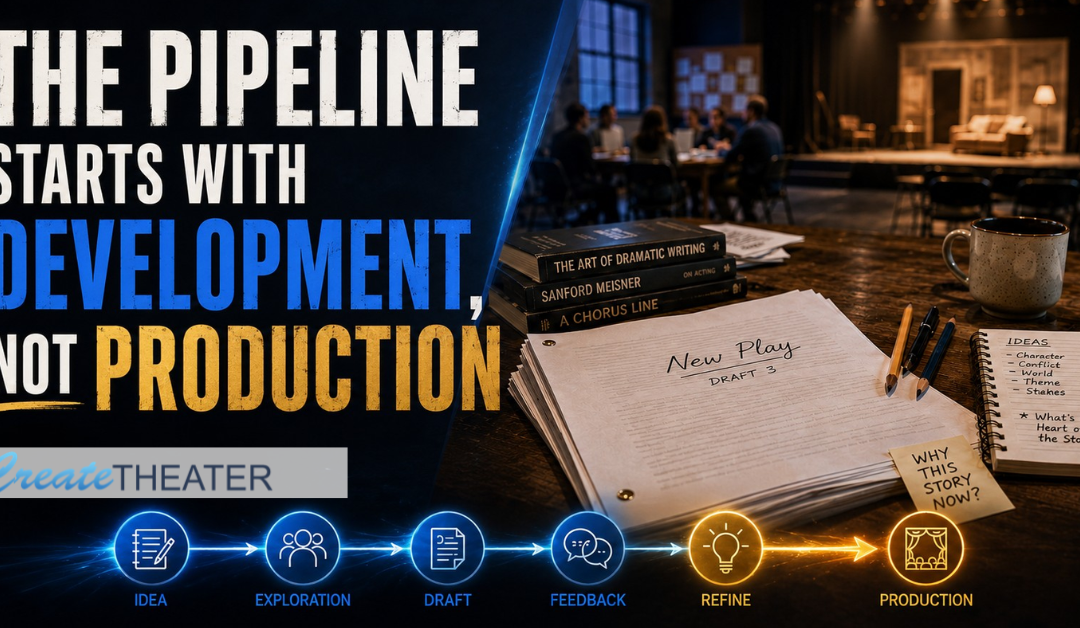
Production is not where the pipeline starts.

Development is.

And if you try to skip that step, rush through it, or pretend you are “ready” before the work has actually been tested, challenged, deepened, and strengthened, you are taking a much bigger risk than you may realize.

I know I may be preaching to the choir here, but during this summer season I see too many writers spend money on various festivals – and then be disappointed.

Not because they were disappointed with their work – but because they were disappointed that the results they dreamed about didn’t materialize.


The Truth About Festivals

Look, I know theater is tough. But here’s the truth:

Production is expensive.

Audiences are honest.

And industry people have long memories.

A mediocre production of a promising play can do more damage than no production at all.

That may sound harsh.

Good. It should.

Because if you care about your work, you cannot afford to treat development like some annoying little hurdle you have to clear before the “real” thing happens.

You do not want to rush into a “festival production.”

Development is the real thing.

It is where the real work begins.


What Happens When You Produce Your Work Too Soon 

There is a dangerous fantasy floating around among a lot of writers.

It goes something like this:

“If I can just get my show on stage, then everything will change.”

Well … maybe.

But maybe not.

Because getting your show on stage too soon is not always a win.

Sometimes it means the writer had access to money before the play had access to enough development.

Sometimes it means the show got onstage before it knew what it was.

Sometimes it means someone was so eager to make something happen that nobody told them to slow down long enough to ask the harder questions:

  • Is the story actually clear?
  • Does the structure hold?
  • Are the stakes high enough?
  • Does the ending land?
  • Do the characters have enough dramatic agency?
  • Is the audience emotionally tracking the journey?
  • Is this really a producible play — or is it just a strong draft someone really wants to be on stage?

Argh.

How many shows have you seen where you walked away shaking your head and asking, “How on earth did this script get on stage?”

The problems in your script do not magically disappear because you found a venue, hired a director, raised some money, and got your friends to come cheer you on opening night.

In fact, production often makes those problems louder.

Much louder.

Because once the work is in front of an audience, the weaknesses are no longer private.

They are public.

And like I said, the theater industry has a long memory.

A looong memory.

You may never get a second chance to make your show live up to its promise.


Think of Development as Insurance.

I know development can feel frustrating. And it takes so long.

You rewrite the draft.

Then you get notes.

Then you revise.

Then you hear it out loud.

Then you discover the second act has a problem.

Then someone gives you feedback you do not want to hear.

Then a director asks a question that makes you realize the emotional center of the play is not where you thought it was.

Then an audience laughs in the wrong place.

Or worse, they do not respond at all.

And you think:

“Am I ever going to get this play produced?”

I understand that feeling. But development is not punishment.

It is not busywork. And it shouldn’t feel like “developmental hell.”

It is the work. It furthers the work.

Development is insurance.

It is the process that protects the play before you put it under the heat of full production.

It gives you time to hear the work in different ways: with different actors, different directors, different audiences, dramaturgs, producers, and collaborators who can help you see not only what is on the page, but what is actually happening in the room.

That matters. Theatre is a collaborative art.

Because one person’s opinion is not development.

One reading is not development.

One enthusiastic friend telling you “I love it” is not development.

And one industry person giving you a note that sounds smart does not mean you should immediately rebuild your entire play around it.

Development is the process of learning how to listen.

To listen to your play. To listen to the room when your play is being read.

Does it hold the audience?

Or do they get distracted and pull out their phones?

Learn to hear what the work itself is telling you.

That takes time.

It also takes discernment.


CreateTheater Is Development

This is why I created CreateTheater.

Even the name denotes a process.

I didn’t form a theater company to rush writers into production before the work is ready, or to move half-developed scripts into festival showcases.

And I am not here to sell the fantasy that every writer dreams of: seeing their work in front of an enthusiastic audience before the piece is actually ready to meet them.

CreateTheater is a developmental theater company.

We concentrate on the part of the process many people would prefer to skip:

  • The messy middle.
  • The rewriting.
  • The hard questions.
  • The table reads.
  • The feedback.
  • The structure.
  • The audience response.
  • The honest conversation about what is working, what is not working yet, and what the piece needs next.

Because if your goal is to move toward production, the work has to be strong enough to survive production.

That is what a professional development pipeline is designed to do – to carefully learn what your show really needs.


Start Development This Summer

Our Production-Ready Writers™ 6-Month Play Writing Groups begin this week.

If you are serious about developing your play, I’d love for you to consider joining us.

How to Beat the Feedback Freeze and Keep Moving Forward

How to Beat the Feedback Freeze and Keep Moving Forward

What to Do With Notes When You’re Feeling Stuck

You’ve just had a table reading and got feedback on your new musical or play.

Oof. You sit through the conversation, scribble some notes. And suddenly, your brain goes silent.

Everything you’ve done feels wrong. You don’t know where to begin. Why didn’t they get it?

Welcome to the feedback freeze, that uncomfortable post-notes paralysis where you’re too overwhelmed to revise, but too self-aware to keep drafting blindly.

We’ve all been there.

The good news? This moment doesn’t mean you’re failing—it means you’re creating something. It means you’re growing as an artist. And if you let it, this moment can become the most transformative part of your process.

Take a deep breath (and maybe take a couple of days), and let’s look at this a bit differently.

Yes, it can be overwhelming. Here’s some tricks that my writers use to move through the freeze and keep creating. 

Feel First. Don’t Fix. Not Yet.

Before you do anything practical with you feedback—feel your feelings. Let yourself be annoyed. Defensive. Confused. Crushed. Whatever. Allow your feelings to be.

Feedback can feel personal, even when it’s not. The important thing is to give yourself space to emotionally digest before deciding what to do.

Try these:

  • Journaling your gut reactions
  • Taking a walk or 24-hour pause
  • Reminding yourself: Notes are about the work, not your worth

Processing first means you won’t overcorrect or reject ideas just because they hurt.

Sort the Useful from the Noise

Not all feedback is created equal. Some notes are gold. Others are well-meaning… but not necessarily correct for your work.

Ask yourself:

  • Does this feedback align with what I’m trying to make? Does it feel right somehow to me? Is it something that I’ve suspected myself?
  • Is it pointing out a real problem, even if the suggested fix isn’t right?
  • Have I heard this more than once?
  • Do I trust the feedback given from this particular individual?

Create three buckets:

  • Definitely Use
  • Maybe/Needs More Thought
  • Not Helpful for This Draft

It’s important to let your own artistic sense and goals guide the filter before you change even a single word in your script.

Build a Feedback-to-Action Workflow

Once you’ve sorted everything out, translate your top notes into clear, bite-sized actions.

Instead of “make the second act tighter,” try:

  • “Cut 5–7 minutes from Act 2”
  • “Clarify character X’s decision at midpoint”
  • “Reorder scenes 7 and 8 for better momentum”

Think like a director giving yourself cues. Make it actionable.

Use tools like:

  • A revision spreadsheet
  • Sticky notes by scene on the wall
  • Index cards with individual notes per moment

The goal: to transform abstract feedback into a concrete to-do list instead of stewing in your thoughts.

Give Yourself Time—But Not Too Much

You don’t have to implement feedback right away. In fact, rushing can lead to muddy drafts.
But beware the other trap: overthinking yourself into a corner.

Instead, try:

  • Setting a date to revisit the notes with fresh eyes
  • Giving yourself a short feedback “cooldown” window—3 to 5 days max, then taking another look
  • Schedule a “next step” writing session before you feel totally ready

You’ll get clarity faster when you’re back in motion and thinking clearly.

Set Mini-Goals Based on the Notes

You don’t have to fix everything at once.

Start with one mini-goal:

  • “Improve the inciting incident’s clarity”
  • “Revise character B’s final song lyric”
  • “Draft a new scene that addresses note X”

Each small step rebuilds your momentum. And the more you do, the more your confidence returns.

Remember: Feedback is fuel. Not a final verdict.

You’re an artist. A writer. The builder of this unique and interesting world. Notes are there to support your vision—not replace it.

So feel your feelings. Take what helps. Break it into action. And keep writing the story only you can tell.

Want a community to help you process and act on feedback?
Think about joining our Writer’s Residence, the Experts Theater Company.

How to Make Progress When You Don’t Know Your Show’s Ending Yet

How to Make Progress When You Don’t Know Your Show’s Ending Yet

For Playwrights and Musical Theater Writers Who Thrive in Discovery Mode

You’ve got a great setup. Characters who pop. A world that feels rich with possibilities. But there’s just one little issue…

You have no idea how your show ends.

Or you have an idea, but it’s not landing yet.

Sound familiar?

If you’re a playwright or musical theater writer trying to write a new piece without a clear roadmap, you’re not alone—and you’re not doing it wrong. Sometimes the ending comes to us first, but then other times it doesn’t. We’ve created characters first, maybe, but we can’t quite nail the ending.

What to do?

This is very much on my mind currently, as I’m producing a play to open in June and, well, the ending still hasn’t “revealed itself.” Yikes.

Plenty of brilliant, finished shows started out as messy, half-formed drafts written by writers who trusted the process before they knew the destination.

Here’s some suggestions we’re using to keep making progress on your new script without knowing the ending yet.

Embrace “Discovery” Writing

Not everyone writes from an outline—and that’s okay. Discovery writing (also called “pantsing”) means you find the story by writing it. You let your characters talk, get into trouble, and surprise you. It’s organic. It’s chaotic. And it can lead to some of your most original ideas.

The key is to stay curious instead of panicked. If you don’t know where it’s going yet, that’s not a failure—that’s fuel. You’re exploring the terrain while building the map.

Explore Your Characters’ Wants and Raise the Stakes

When you can’t see the end, zoom in on your characters’ desires. What does each of them want—emotionally, practically, spiritually? What’s in their way?

The more clearly you understand what’s driving them and the obstacles in their way, the more naturally plot points and conflicts will arise. Ask yourself:

  • What would they do next to get what they want?
  • What would challenge them the most?
  • What are they afraid of losing?

The answers might lead you to your next scene—or your eventual ending.

Write the Middle with a Flexible Mindset

The middle of your show is where things evolve, deepen, and get complicated. Even without a firm ending, you can write scenes that test relationships, raise the stakes, and introduce twists (typically the midpoint reversal) that excite you.

Be flexible. If a character veers off course or a subplot emerges unexpectedly, follow it for a bit. Revision is where you make it neat. Drafting is where you let it be messy and alive. Have more fun with this! The more fun you have now, the more fun your audience will have later.

Use “What If” Scenarios as Your Daily Prompts

Stuck? Try “what if” questions to jumpstart your writing:

  • What if the antagonist suddenly helped the protagonist?
  • What if the lovers don’t end up together?
  • What if someone makes the wrong choice and it spirals?

These prompts don’t have to “fit” your eventual structure. They’re experiments to discover new layers in your story. Some might stick. Others might spark ideas you didn’t expect.

Track Your Theme and Emotional Arcs

Even if the plot isn’t clear, your theme can be. What are you trying to say? What feeling or idea keeps bubbling up as you write? What “gift” are you wanting to give the audience at the end?

Track how your characters are emotionally changing from scene to scene. Are they getting closer to something? Losing something? Growing?

Emotional arcs can anchor your show even before the structure is solid. If you follow the emotional truth, the ending often reveals itself when the time is right.

Keep Going, Even If It’s Imperfect

A draft doesn’t have to be linear. It doesn’t have to be “complete.” It just has to exist.

You’ll revise. You’ll cut. You’ll rewrite the ending three times. But if you stop writing because you don’t know where it’s going, you’ll never find out.

So trust your instincts. Let the show teach you what it wants to be. And remember: the ending might not be what you planned—but it might be exactly what your show needs.

Remember, a play is never “finished” – it’s just produced.

What We’re Doing Now:

Among other things, I’ve hired a director who lives in the world of the play, and a really smart playwright/dramaturg who does not. It helps to have divergent opinions to fully round out the characters clearly.

We’re having heady intellectual and psychological discussions between the four of us (playwright, producer, director and dramaturg) about every character, motive, and scene, reviewing the moment-to-moment stakes and thoughts motivating action. Over Zoom, as we’re working artists with commitments out of NYC.

We’re reviewing external documents that shape the issues in the world of the play together, to fully understand the lived experience of the family we’re portraying, and the issues they believe in.

Heady stuff, but all in all an exhilarating creative process. And I know the show will benefit from this research.

Your Turn:
How about you? Are you writing a musical or play without knowing the ending yet? What helps you keep going?

Share the way you go about your creative process (or pose questions) in the comments! We’d like to hear what you do.