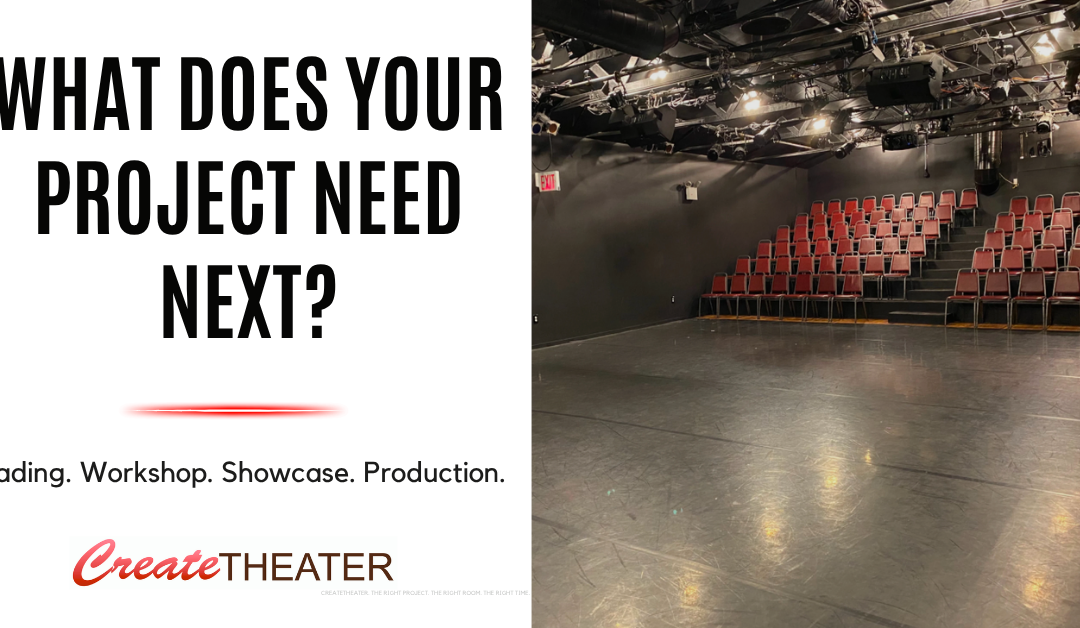
The Next Step After a Successful Workshop

The Next Step After a Successful Workshop

One of the most common mistakes I see in new-work development is the assumption that there is a correct sequence.

First a reading. Then a workshop. Then a showcase. Then, if all goes well, a production.

But that isn’t really how development works.

A successful developmental step does not automatically tell you what comes next. It gives you better information about the work.

And then someone has to decide what to do with that information.

That, increasingly, is how I think about the work of the creative producer.

The question is not simply, “Was this successful?”

The more useful question is:

“What does this particular project need next?”


Sometimes a production sends you back into development

This week at CreateTheater, we returned to JACQUES AND JILL, a new musical by Jarlath Jacobs.

That project has actually been on a stage before. We produced an earlier version of the musical at Theatre Row as part of our 2022 New Works Festival.

It would be easy to look at that history and assume the next step should simply be another, larger production.

Instead, Jarlath went back to the work.

Now living in Como, Italy, she has been substantially rethinking the story and developing what has become JACQUES AND JILL. We are hearing the new version again in our Monday Night Reading Series, act by act.

That is not going backward.

It is development doing exactly what it is supposed to do.

Sometimes putting a piece in front of an audience reveals that the fundamental idea is worth pursuing—but that there is another, stronger version of the story still waiting to be discovered.

A prior production does not mean the work can never return to the development room.

Sometimes that is precisely where it belongs.


Sometimes a successful workshop reveals the next rewrite

We had a very different experience recently with LITTLE THINGS, the new musical by David H. Smith.

After developing the musical through CreateTheater—and previously presenting both an industry reading and a cabaret version of the work—we brought it to Philadelphia for a workshop production.

The performance sold out.

The audience response was wonderful.

It was a real success.

And there will still be rewrites.

One of the clearest things we learned from seeing the full musical on its feet is that the overall running time needs to come down.

That is exactly the kind of information a workshop is supposed to give you.

A workshop allows you to experience the show in time and space. You begin to feel pacing differently. Transitions that seemed perfectly reasonable on the page suddenly have weight. Songs, scenes and storytelling beats begin competing for the audience’s attention in ways that are almost impossible to judge from a table reading alone.

The success of LITTLE THINGS did not eliminate the need for development.

It made the next developmental task clearer.

And that is a success too.


And sometimes you don’t need the workshop at all

Then there is The Blue Violinist Over West End Avenue.

Its path has been completely different.

We did not move the play through a workshop production or a showcase.

There was a succession of readings and extensive script development. But because of the strength and timeliness of the story, the decision was made to move the play directly toward an Off-Broadway production.

That did not mean the script stopped developing.

Last week, the writer, the director and I spent more than six hours together in person working through the play.

We read it aloud.

We stopped.

We questioned moments.

We adjusted language.

We worked through transitions, beats, intentions and the internal logic of scenes moment by moment.

It was extraordinarily detailed work.

And yet it was happening on a play already heading into production.

Why?

Because the developmental process is not determined by which boxes you have checked.

It is determined by what the work still needs.


Every show needs something different

That is why I resist prescriptive development pipelines.

A reading can be invaluable when you need to hear structure, language or character relationships.

A workshop becomes essential when you need to understand physical storytelling, pacing, staging, musical integration or audience response.

A showcase can be useful when the work is sufficiently developed and you need other people to experience its theatrical potential.

And sometimes a project is ready to move toward production without passing through every one of those stages.

The producer’s job is not to march every project through the same sequence.

The producer’s job is to diagnose the work.

What questions are still unanswered?

What can we learn in the room we are in now?

What kind of room would help us answer the next question?

And perhaps most importantly:

Are we still asking fundamental story questions—or are the remaining questions becoming production questions?

That distinction matters.

If we are still struggling with what the protagonist wants, why Act Two exists, whose story we are telling, or what the piece ultimately means, then the work probably needs more development.

If the questions are increasingly about performance, design, rhythm, staging and audience experience, the project may be approaching a different threshold.

It may be ready to become a production.

There is no universal roadmap.

JACQUES AND JILL needed to return to the story.

LITTLE THINGS needed to meet an audience so we could discover what to tighten.

THE BLUE VIOLINIST OVER WEST END AVENUE needed intensive, detailed script work inside a production process.

Three projects.

Three different paths.

That is what new-work development actually looks like.

The goal is not to keep pushing a project forward simply because “forward” sounds like progress.

The goal is to put the work in the right room at the right time—and to know what you need to discover.


What does your project need next?

Before you schedule another reading, submit for another festival, or start thinking about production, ask yourself one question:

What is the most important thing I still need to learn about this piece?

Your answer will tell you what the next room should be
Not sure what your project needs next?

Subscribe to The Producers Room for weekly guidance on moving new work forward.

Not Every Script is Ready for a Showcase

Not Every Script is Ready for a Showcase


There is a moment in the development of a new play or musical when the writer begins to ask a very understandable question:

When can I get this in front of industry?

Maybe the script has had a few readings. Maybe it has been through a writing group. Maybe the writer has spent months—or years—rewriting it. At some point, the natural impulse is to move outward: invite producers, artistic directors, literary managers, directors, investors.

In other words: showcase it.

But here is something I have become increasingly clear about as a producer:

Not every script is ready for a showcase.

And that is not a judgment on the quality of the writer or even the potential of the work.

It is a question of timing.


A Showcase Creates Expectations

The word showcase can sound deceptively casual.

We sometimes treat it as simply another developmental step: first a reading, then a workshop, then a showcase.

But a showcase is different because the purpose of the room changes.

A developmental reading asks:

What does the piece need?

A showcase begins asking:

What could happen to this piece next?

That distinction matters.

Once you invite industry professionals into the room, you are asking them to begin imagining the work beyond development.

Could this fit our season?

Would I produce this?

Would I direct this?

Could I introduce this writer to someone?

Is there an audience for this?

What would it cost?

That means the work is being evaluated differently.

And you want the script to be strong enough to benefit from that attention.


More Exposure Is Not Always Better

Writers are understandably encouraged to get their work seen.

And yes—new work needs advocates.

But there is a difference between getting the work seen and getting the work seen at the right moment.

Premature exposure can work against you.

If an artistic director sees a script before its central dramatic problem has been solved, they may simply conclude that the script does not work.

They may never know that six months later the writer completely restructured Act Two.

If a producer watches a musical before the score, book, and dramatic architecture are working together, they may remember the weaknesses rather than the potential.

You rarely get to control when someone will encounter your work again.

That is why I do not believe showcases should be consolation prizes, graduation ceremonies, or automatic benefits of belonging to a development program.

They are strategic opportunities.

And strategy requires asking whether the work is actually ready.


So What Does “Ready” Mean?

It does not mean perfect.

There is no such thing as a finished new play or musical that will never change again.

Even productions continue teaching us about the work.

But before I would want to put a piece into an industry-facing showcase, I would want to see several things happening.

The dramatic engine of the piece should be clear.

The audience should understand whose story they are following, what that person wants, and what stands in the way.

The structure should basically hold.

There may still be cuts, rewrites, new songs, scene changes, and discoveries ahead. But the piece should no longer be searching for its fundamental architecture.

The major emotional turns should land.

The writer should have already heard the work aloud—preferably more than once—and made discoveries from actors and audiences.

And perhaps most importantly:

We should know why we are doing the showcase.

“Because I want industry people to see it” is not quite enough.

  • Which industry people?
  • And what do you want them to do next?
  • Are you looking for a producing partner?
  • A regional theater?
  • A commercial producer?
  • A director?
  • A developmental residency?
  • Investors?
  • An artistic home?

The clearer the next objective is, the more useful the showcase becomes.


Sometimes the Best Next Step Is More Development

This is the part writers sometimes find frustrating.

They have worked hard. They are eager to move forward.

And then the producer says:

I think we need another reading.

Or another rewrite.

Or a workshop.

That can feel like standing still – and possibly make you angry.

But development is not standing still when it is answering a specific question.

A table reading might reveal whether the storytelling is clear.

A music rehearsal might expose a structural problem in a musical.

A staged workshop can tell us whether transitions, pacing, physical storytelling, and theatrical moments are functioning.

Each form of development gives us different information.

The goal is not to accumulate development credits.

The goal is to solve the problems that stand between the work and its next opportunity.


This Is How I’m Thinking About CreateTheater’s 2027 Showcases

We are beginning to look toward CreateTheater’s 2027 Showcase productions (as well as our 2027 New Works Reading Festival).

But regarding the showcases, my question is not simply:

Which writers deserve an opportunity?

There are many writers I believe in.

My question is:

Which projects are ready for this particular opportunity?

Those are not the same thing.

One project may be ready for a showcase.

Another may need six more months of focused development.

Another may need a table reading before anyone makes that decision.

Another may actually be ready to move beyond a showcase toward production conversations.

That is the kind of pipeline that CreateTheater has built.

Not a conveyor belt where every project automatically advances to the same next step.

A developmental process in which the opportunity matches the readiness of the work.

Because the goal is not simply to present a script.

The goal is to help that script move forward.


The Better Question

So if you are developing a new play or musical, I would encourage you to replace:

“How do I get a showcase?”

with:

“What does my work need next?”

Sometimes the answer will be a showcase.

Sometimes it will be another reading.

Sometimes it will be a workshop.

Sometimes it will be a serious rewrite.

None of those answers mean you are behind.

They mean you are developing the work strategically.

And when the right opportunity finally arrives, you want the piece to be ready to take advantage of it.

Because in new work development, the opportunity must match the readiness of the work.

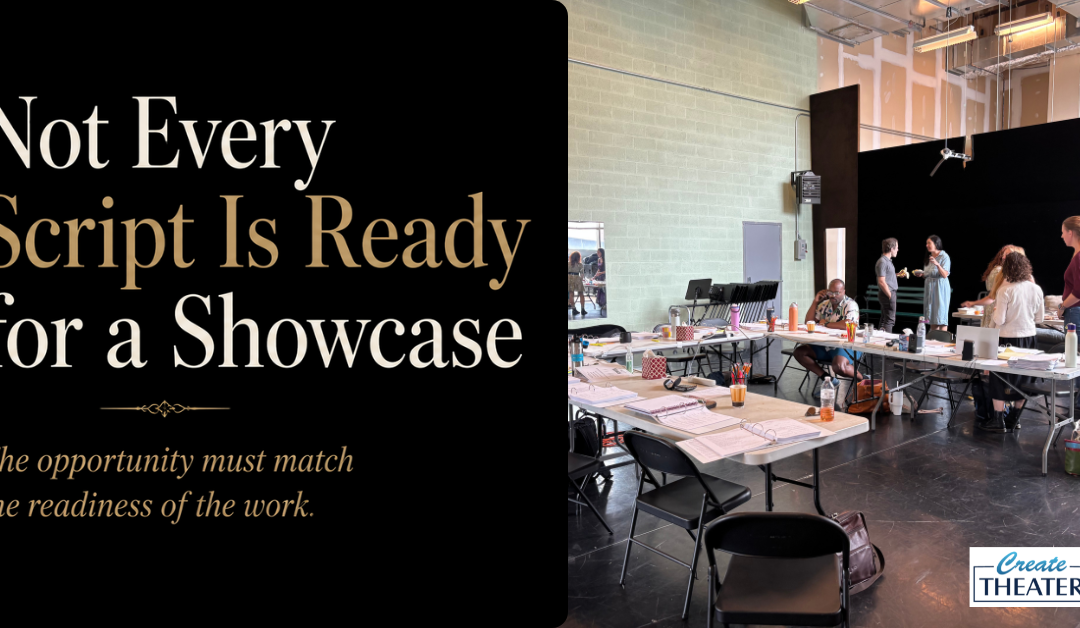
(NOTE: Image is from the first day of rehearsal for the next musical LITTLE THINGS by David H. Smith at the Philadelphia Theater Company.)


Want to follow how CreateTheater develops new plays and musicals toward readings, workshops, showcases, and production? Join the CreateTheater newsletter and come inside the development room.

Come join us at the Philadelphia Theater Company for LITTLE THINGS on August 29th at 3pm